
Blog
Farm Equipment Appraisal for Divorce: How Tractors, Combines, and Sprayers Get Valued as Marital Assets
A farm equipment appraisal for divorce establishes what tractors, combines, and sprayers are actually worth on the open market so courts can divide them as marital assets. This guide covers how fair market value is determined, why independence and USPAP compliance matter, and what to expect during the process.
Why Farm Equipment Is Often the Largest Marital Asset in a Farm Divorce
In a farm divorce, land usually gets the attention, but the equipment fleet often carries more value than either spouse expects. A modern combine, a matched set of tractors, sprayers, and tillage equipment can easily run into six figures, and unlike land, machinery depreciates, wears, and turns over on a schedule that has nothing to do with a divorce timeline. When two people who built a farm operation together need to divide it, the equipment list becomes one of the first things attorneys ask about, right alongside the real estate.
A farm equipment appraisal establishes what that fleet is actually worth on the open market, separate from what either spouse remembers paying for it or what a lender's depreciation schedule says it is worth today. That distinction matters because farm equipment sits at the intersection of a working business asset and a marital asset, and courts need a number that reflects what the equipment could sell for, not what it cost or how it was financed.
Tractors are usually the equipment appraisers get asked about first, since a farm operation may run two or three tractors of different sizes and vintages, each with its own value trajectory. A tractor appraisal that isolates each unit's make, model, hours, and condition gives the attorneys a clean, itemized starting point rather than a single lump estimate for "the equipment."
How Equitable Distribution and Community Property States Treat Farm Machinery Differently
State law decides which farm equipment counts as marital property and how it gets divided, not the appraiser. In equitable distribution states, courts generally classify each asset as marital or separate property first, then value the marital portion as of a specific date the court selects, then divide it according to statutory factors such as each spouse's contribution to the farm operation. Cornell Law School's overview of equitable distribution describes this classify-value-divide sequence as the standard framework most equitable distribution states follow.
Florida's statute, for example, directs courts to start from a presumption of equal distribution of marital assets unless there is justification for an unequal split, and it ties passive appreciation calculations to a valuation date set in the dissolution action. Pennsylvania's equitable distribution law takes a similar approach, directing courts to equitably divide, distribute, or assign marital property, and allowing the court to weigh each asset or group of assets individually rather than applying one blanket rule to the whole estate.
Community property states work differently: property acquired during the marriage is generally treated as owned equally by both spouses from the outset, rather than something a court divides equitably after the fact. Either way, the appraiser's job stays the same: confirm with the client or the client's attorney which value standard applies (fair market value, net value, or value in use) and which effective date the case requires, then value the equipment to that standard. The appraiser does not decide the legal classification or the applicable value definition; that comes from the jurisdiction and the attorney directing the case.
How Fair Market Value Is Determined for Tractors, Combines, and Sprayers
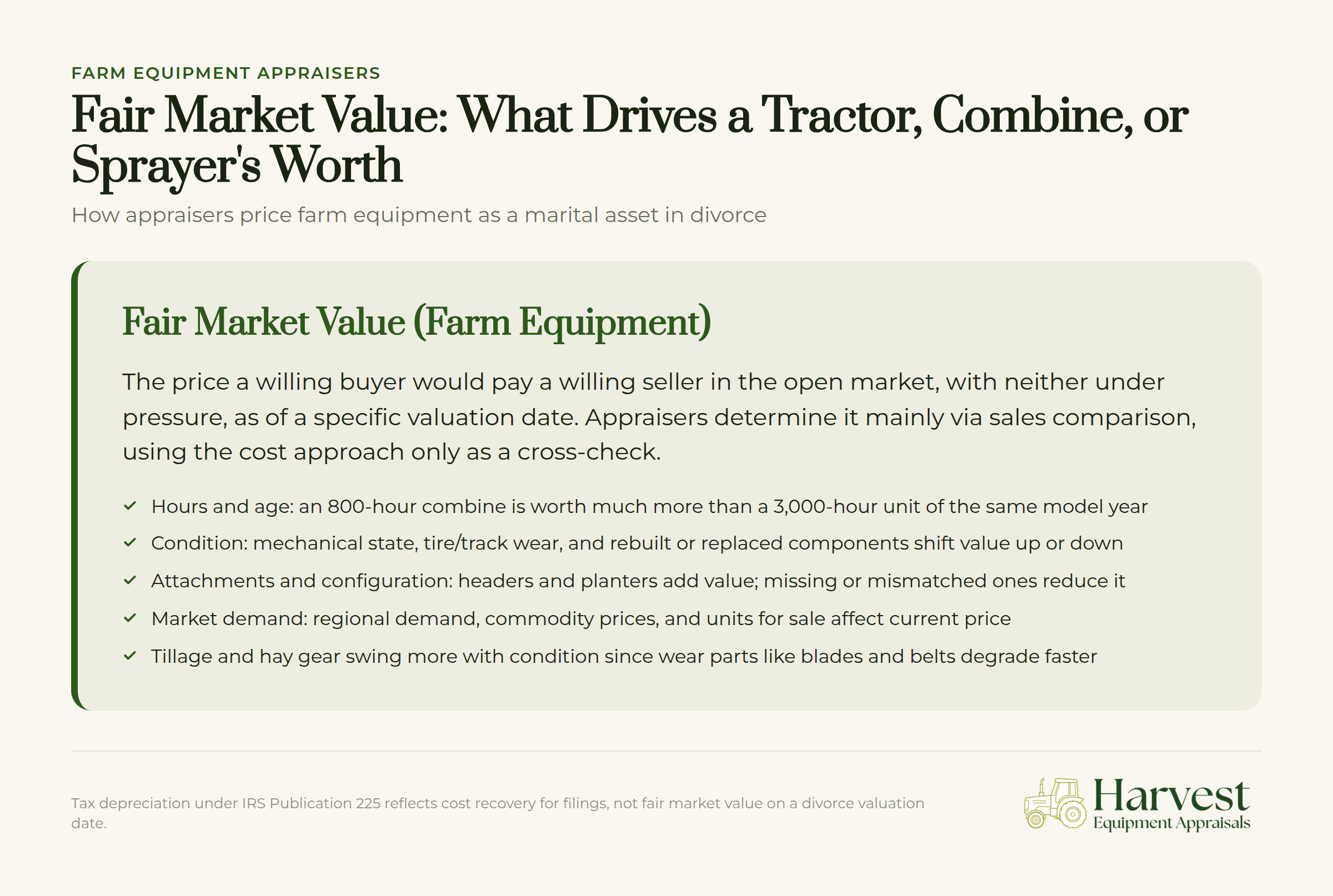
Fair market value for farm equipment is what a willing buyer would pay a willing seller in the open market, with neither side under pressure to act, as of a specific date. Appraisers reach that number primarily through the sales comparison approach: pulling recent sales and asking prices for comparable makes, models, and configurations, then adjusting for differences in hours, condition, and attachments. The cost approach, which estimates replacement cost new minus depreciation, serves mainly as a cross-check rather than the primary method, since used equipment rarely trades at a price that tracks its depreciated book value.
Several factors move the needle on value for any given unit:
- Hours and age: A combine with 800 separator hours is worth substantially more than the same model with 3,000 hours, even if both were manufactured the same year.
- Condition: Mechanical condition, tire or track wear, and whether major components have been rebuilt or replaced all shift value up or down.
- Attachments and configuration: Headers, planters, and specialty attachments sold with a unit change its value, and mismatched or missing attachments reduce it.
- Market demand: Regional demand, commodity prices, and how many similar units are currently for sale all affect what a comparable unit is actually fetching right now.
Tillage and hay equipment (discs, field cultivators, balers, mowers) tend to see steeper condition-driven swings than tractors and combines, because wear parts such as blades, tines, and belts deteriorate faster and are easier to overlook during a quick walk-through. Appraisers cross-reference recognized equipment guides and market data alongside comparable sales; industry pricing services such as Iron Solutions and JD Power's farm equipment guides are commonly used as a starting benchmark before adjusting for the specific unit's actual condition and local market.
It's worth noting that tax depreciation schedules and fair market value are not the same thing. The IRS treats farm machinery and equipment as a depreciable business asset for tax purposes under IRS Publication 225, but that depreciation schedule reflects cost recovery for tax filings, not what the equipment would actually sell for on the valuation date a divorce case requires.
Why Independence and USPAP Compliance Matter When Both Spouses Have Competing Numbers
When both spouses have a stake in what the equipment is worth, an independent appraisal is the only number either side can trust. The spouse keeping the farm has an incentive to value the fleet low; the spouse being bought out has an incentive to value it high. Neither number is reliable if it comes from someone with a financial interest in the outcome, which is exactly why courts and attorneys ask for a third-party appraisal rather than relying on either party's own estimate.
An appraisal prepared in accordance with USPAP (the Uniform Standards of Professional Appraisal Practice) documents the methodology, the comparable sales relied on, and the reasoning behind every adjustment, so either attorney can review how the number was reached. Our appraisers hold credentials with organizations such as ASA, CAGA, and NEBB, and every farm equipment engagement follows the same USPAP framework regardless of whether the intended use is divorce, financing, insurance, or a tax filing.
Watch out: No appraiser can promise a report will be "court-accepted." Courts and jurisdictions decide which value standard applies and whether a given report meets that standard; the appraiser's job is to confirm the required standard with the client or attorney before starting, then produce a defensible, well-documented opinion of value that fits it.
What to Expect During the Farm Equipment Appraisal Process
Farm equipment appraisals for divorce follow a straightforward sequence, but each step depends on information only the client and the attorney can provide.
- Provide an equipment list and documentation. The appraiser needs make, model, serial number, hours, age, attachments, and any maintenance or purchase records for every unit being valued, from the main tractor down to the smaller tillage implements.
- Confirm the required value standard and effective date. Fair market value is the most common standard, but some jurisdictions or attorneys may request net value or value in use instead. The effective date (date of separation, date of filing, or another date the court sets) varies by jurisdiction, and the appraiser works from whatever date the client or attorney specifies.
- Complete the inspection. Depending on the scope and location, this happens on-site or through a detailed online appraisal process using photos, video walk-throughs, and hour meter readings, which works well for equipment fleets spread across multiple locations.
- Analyze comparable sales and market data. The appraiser researches recent sales of comparable equipment, cross-references recognized pricing guides, and adjusts for condition, attachments, and regional demand.
- Deliver the written report. The final report identifies each asset, states the value standard used, documents the comparable sales and adjustments, and presents the concluded fair market value for each unit and for the fleet as a whole.
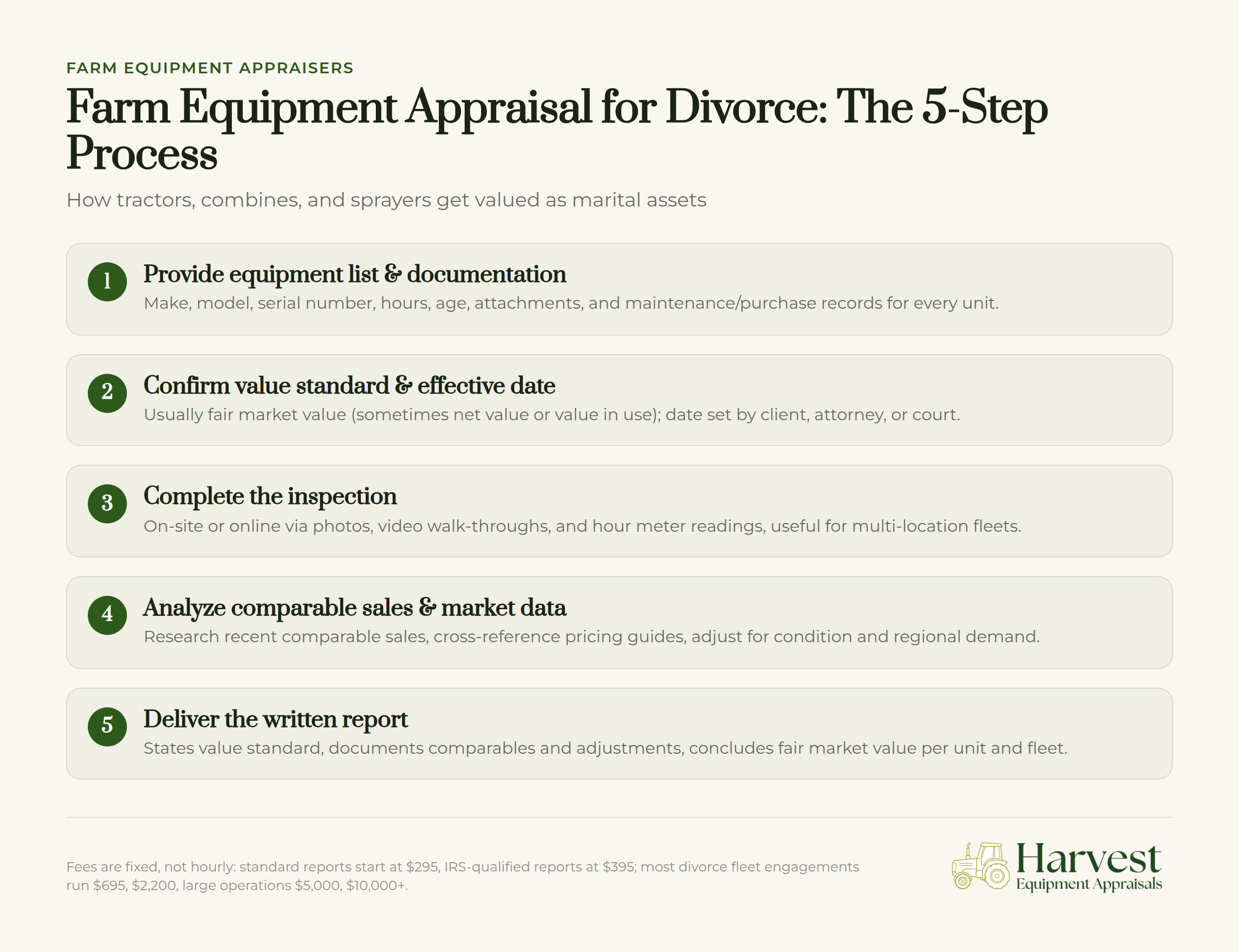
Farm equipment appraisal fees are quoted as a fixed fee after the appraiser scopes the assignment, never billed hourly and never priced off the equipment's market value. Standard reporting typically starts at $295, an IRS-qualified report starts at $395, and most divorce engagements for a working fleet fall between $695 and $2,200 depending on the number of units and documentation involved. A large or highly specialized operation with many units can run $5,000 to $10,000 or more.
Get an Independent Valuation Before You Negotiate
Farm equipment doesn't sit still while a divorce works its way through the courts. Tractors keep depreciating, hours keep accumulating, and market prices for used combines and sprayers keep moving with the season. Getting an independent, USPAP-compliant valuation early gives both sides a documented starting point instead of two competing guesses, and it holds up better under attorney review than an estimate either spouse pulled from a dealer trade-in quote.
If you're heading into equitable distribution and need the farm equipment valued, request an appraisal and our team will scope the assignment, confirm the required value standard with your attorney, and deliver a report built to stand up to review from both sides.
This article is provided for general informational purposes only and does not constitute legal, tax, or financial advice. Readers should consult a qualified attorney or CPA regarding their specific circumstances.