
Blog
Farm Equipment Appraisal for Probate: How It Works in Estate Settlement
A farm equipment appraisal for probate establishes the date-of-death fair market value that courts, executors, and heirs all rely on. This guide walks through why the appraisal is required, what the report must contain, and where it fits in the probate timeline.
When a farmer or rancher passes away, the tractors, combines, planters, and trailers in the yard become part of an estate that a court must account for before anything is distributed. An executor cannot simply guess at what that equipment is worth. Probate courts and the IRS both expect a documented, defensible number, and for most farm estates that number comes from an independent farm equipment appraisal. This guide walks through why that appraisal matters, what the report needs to include, and how it moves through the probate process.
Why Probate Requires an Independent Farm Equipment Appraisal
Probate is the court-supervised process of inventorying a decedent's property, paying debts and taxes, and distributing what remains to heirs. Farm equipment is almost always one of the largest line items in a farm estate's personal property inventory, and state probate statutes generally require the personal representative to file that inventory with the fair market value of each asset as of the date of death, not its original purchase price or a guess at scrap value (Pierce Law's overview of probate inventory rules).
Equipment values also tend to be exactly where disputes start. One heir thinks the combine is worth $180,000 because that's roughly what a similar model listed for online; another heir remembers dad saying it needed a new engine. Multiply that disagreement across two dozen or more pieces of equipment and the estate can stall for months. An independent, third-party appraisal takes the guesswork and the family politics out of the number. Because the appraiser has no financial stake in the outcome, the report gives the court, the executor, and every heir the same defensible figure to work from.
Our farm equipment appraisal for probate service is built around this exact need: a USPAP-compliant, third-party valuation that a probate court can rely on without question.
What Fair Market Value Means for Farm Equipment in Probate
Fair market value in a probate appraisal is the price a piece of equipment would have brought between a willing buyer and a willing seller, neither one under pressure to act and both reasonably informed, as of the date of death (IRS Publication 225). That date-of-death standard is not optional. Treasury regulations governing what belongs in a decedent's gross estate generally value that property at its fair market value at the time of death, not at some later liquidation price (26 CFR 20.2031-2).
That date-of-death figure does double duty. It becomes the number the probate court uses to settle the estate, and it becomes each heir's stepped-up basis in the equipment going forward under federal tax basis rules (26 CFR 1.1014-3). If an heir later sells an inherited tractor, their taxable gain is calculated against that stepped-up basis, not against what the original owner paid for it decades earlier. Getting the appraisal wrong doesn't just risk a probate dispute; it can distort a future tax bill for whoever inherits the machine.
In some estates, the executor can elect an alternate valuation date under federal estate tax rules, valuing the estate 6 months after death instead of at death. This is a narrow election available only when it reduces both the gross estate and the resulting estate tax, and it's worth raising with the estate's attorney or CPA early rather than assuming it applies.
Federal Estate Tax Thresholds Rarely Change the Need for an Appraisal
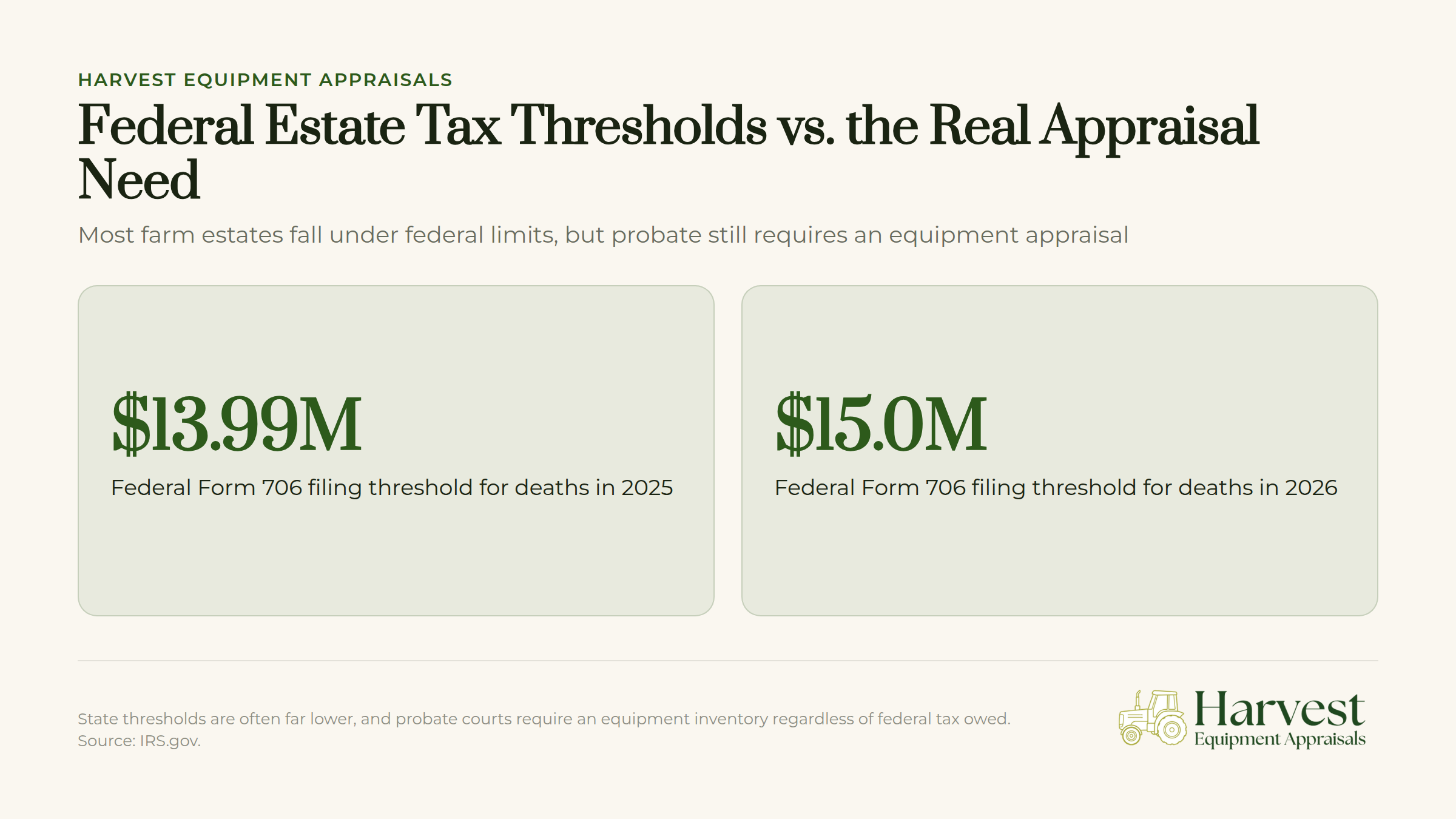
Many executors assume the appraisal only matters if the estate is large enough to owe federal estate tax. The federal filing threshold for Form 706 is $13.99 million for deaths in 2025 and rises to $15.0 million for deaths in 2026 (IRS estate and gift tax updates; IRS 2026 inflation adjustments). Most farm estates fall well under that number even after land and equipment are added together.
But that federal threshold is nearly beside the point for most families. State inheritance and estate tax thresholds are frequently far lower, and probate courts require an equipment inventory and valuation regardless of whether any tax is ultimately owed. The appraisal still matters for equitable distribution among heirs, for setting the stepped-up basis, and for closing the estate cleanly, even when no federal return is ever filed.
Who Hires the Appraiser: The Executor as Client of Record
The personal representative, whether called an executor, administrator, or estate trustee, is the one who engages the appraiser, not the heirs individually. This matters more than it sounds like it should. The appraisal engagement letter and the final report are addressed to the estate through its personal representative, because that is the person with legal authority to act on the estate's behalf and the person the probate court will hold accountable for the accuracy of the inventory. Heirs can (and should) review the report, but the appraiser's client relationship runs through the executor.
Before any appraiser begins work, they should confirm that authority. That typically means requesting a copy of the death certificate and the court document appointing the personal representative (often called Letters Testamentary or Letters of Administration). Skipping that step creates real liability for the appraiser and real risk for the estate if the wrong person is directing the engagement.
What a Probate-Ready Farm Equipment Appraisal Report Must Include
A probate report needs more than a single lump-sum number at the bottom of the page. Farm equipment estates commonly involve anywhere from a couple dozen to 90 or more individual pieces spanning tractors, combines, tillage equipment, grain trailers, and ATVs, and each one generally needs to be itemized and valued separately rather than lumped together, consistent with how the IRS treats farm chattels for valuation purposes (general guidance on itemizing farm machinery for estate valuation).
A complete probate-ready report should document the following for every asset:
- Make, model, and year: the identifying details that let anyone verify what's actually being valued.
- Serial or VIN number: ties the valuation to the specific unit, not a generic model listing.
- Hours or mileage and condition: the primary drivers of value within a given model line.
- Attachments and modifications: loaders, headers, dual wheels, or aftermarket upgrades that change value.
- Comparable sales or auction data: market evidence supporting the concluded value as of the date of death.
- Photographs: visual documentation that supports the condition rating and protects against later disputes.
Our appraisers hold credentials with organizations such as the ASA, CAGA, and NEBB, and every farm equipment report we prepare is built in accordance with USPAP, the Uniform Standards of Professional Appraisal Practice. That standard is what gives a probate court, an attorney, or a skeptical heir confidence that the numbers were arrived at independently and consistently.
Example: An estate includes 34 pieces of equipment: 3 tractors, a combine, a planter, several tillage tools, 2 grain trailers, and a handful of smaller implements. A probate-ready report values each piece individually with its own comparable sales support, rather than presenting a single $410,000 estate-wide figure that no heir can independently verify.
How the Appraisal Fits Into the Probate Timeline
The appraisal typically happens early in probate, right after the executor is formally appointed and before the inventory is filed with the court. Waiting too long delays the entire estate, since most jurisdictions set a deadline for filing the initial inventory.
- Executor Is Appointed
- The court issues Letters Testamentary or Letters of Administration, giving the personal representative legal authority over the estate.
- Appraiser Is Engaged and Scopes the Assignment
- The executor provides a list or lets the appraiser inventory the equipment on-site, and the intended use (probate inventory, IRS filing, equitable distribution) is confirmed.
- Equipment Is Inspected and Valued as of the Date of Death
- Each asset is itemized, inspected or reviewed from records and photos, and valued using market evidence current as of that date.
- Report Is Delivered to the Executor
- The finished report lists every asset with its individual fair market value and supporting documentation.
- Inventory Is Filed With the Probate Court
- The executor submits the equipment values as part of the estate's full inventory, alongside real estate and other assets.
- Estate Is Distributed or Equipment Is Sold
- Heirs receive equipment in kind based on the appraised values, or equipment is sold and proceeds are divided according to those same figures.
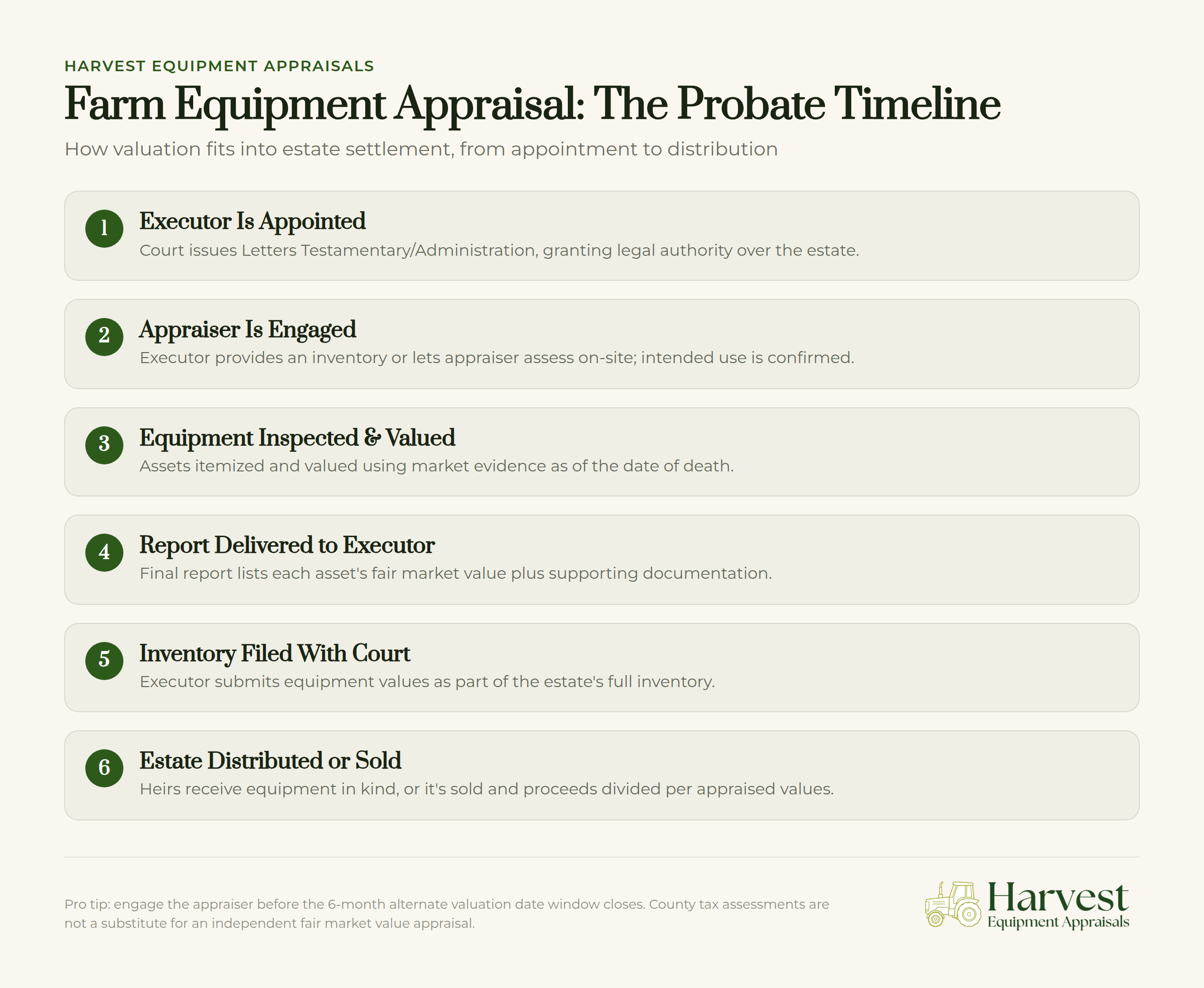
Pro tip: If the estate's attorney or CPA is even considering the alternate valuation date election, get the appraiser involved before that 6-month window closes. A retrospective valuation months after the fact is harder to support with clean market data than one done close to the actual date of death or the alternate date.
Watch out: Local tax assessment values on farm machinery are not the same as fair market value and generally are not controlling for probate or estate tax purposes unless they happen to reflect true market value as of the valuation date. Relying on a county assessment instead of an independent appraisal is one of the more common mistakes we see in farm estates.
What Does a Farm Equipment Appraisal for Probate Cost?
Probate engagements are quoted as a fixed fee determined after we scope the assignment, never billed hourly. The fee depends on the number of assets in the inventory, how many locations the equipment is spread across, whether the intended use requires an IRS-qualified report versus a standard probate valuation, and the overall complexity of the estate. An estate with a dozen pieces of equipment at one farmstead is a very different scope than one with 80 pieces spread across three counties, and the quote reflects that difference before any work begins.
If you're weighing whether a full appraisal is worth it for a smaller estate, our tractor appraisal service page and FAQ on how to find out what a tractor is worth both walk through how value is determined for individual pieces of equipment outside of a full estate engagement.
Settling the Estate With a Number Everyone Can Trust
Farm equipment is often the most valuable, and most contested, category of personal property in a farm estate. A date-of-death appraisal prepared by an independent, credentialed appraiser gives the executor a defensible inventory, gives heirs a fair basis for dividing or selling the equipment, and gives the estate's future tax filings an accurate starting point. Skipping that step, or relying on a rough guess, tends to cost families far more in delay and disagreement than the appraisal itself would have cost.
If you're an executor or heir working through a farm estate, our team can scope your farm equipment appraisal for probate and walk you through what the court and the IRS will expect from the report.
This article is provided for general informational purposes only and does not constitute legal, tax, or financial advice. Readers should consult a qualified attorney or CPA regarding their specific circumstances.