
Blog
Farm Equipment Donation Appraisal IRS Rules: What Farmers Need to Know
Donating a tractor, combine, or implement to a school or 501(c)(3) triggers a qualified appraisal once the claimed deduction passes $5,000. This guide walks through the IRS thresholds, Form 8283 requirements, and why your deduction may be capped at adjusted basis instead of fair market value.
Donating farm equipment to an FFA chapter, 4-H program, or local nonprofit is a generous move, and it can carry a real tax benefit. But the IRS treats a used tractor or combine the same way it treats any other noncash gift: once the claimed deduction crosses a specific dollar threshold, the paperwork requirements get strict. Farmers who skip a required appraisal, or who assume fair market value automatically equals their deduction, often end up disappointed at tax time. This guide covers what triggers a qualified appraisal, who can perform one, how Form 8283 works, and why the deductible amount for depreciated equipment can differ sharply from what the tractor is actually worth. Our farm equipment appraisal team prepares these reports regularly for donors working with schools, ag programs, and community nonprofits.
When Does a Farm Equipment Donation Require an IRS Appraisal?
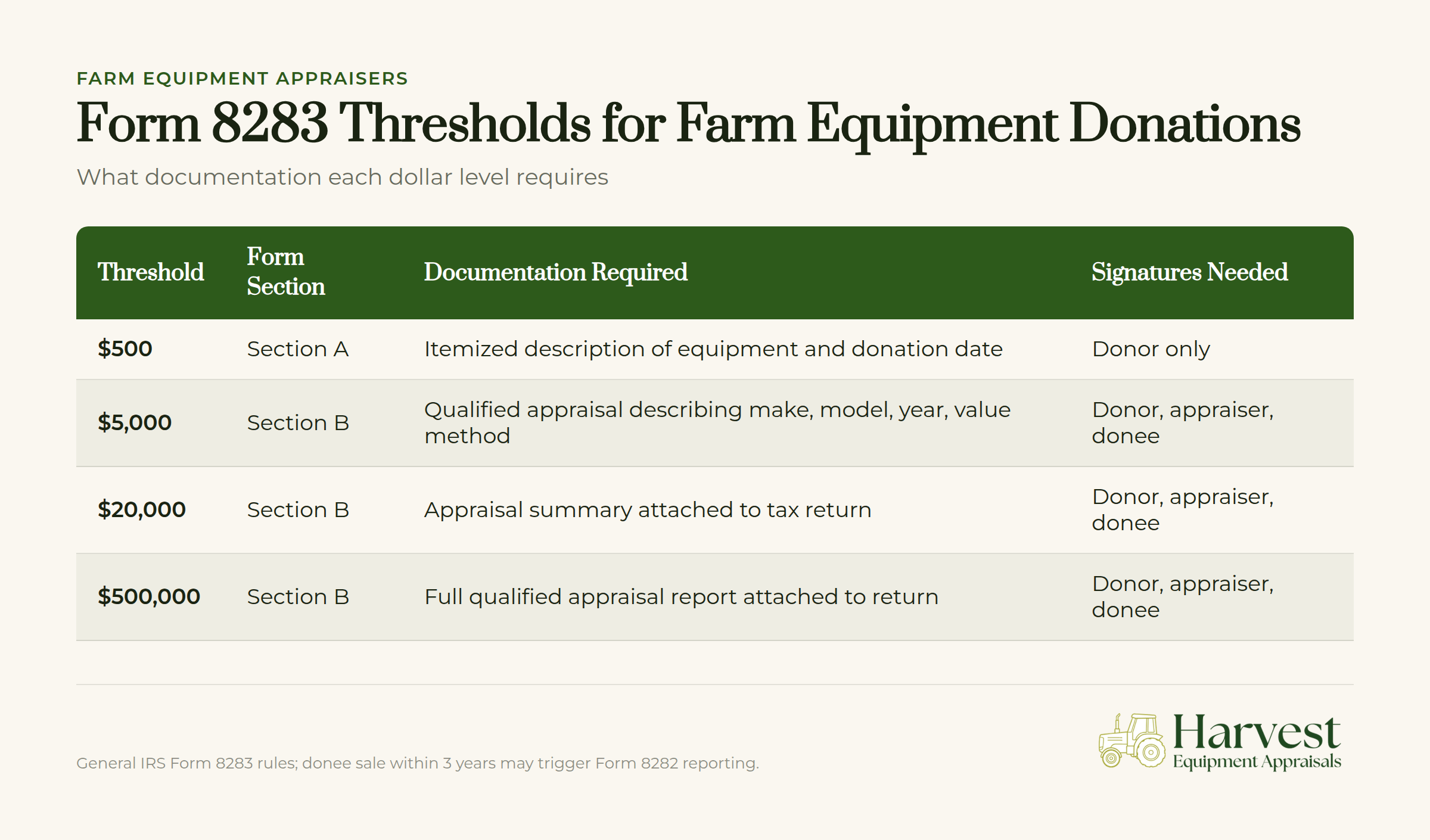
A farm equipment donation requires a qualified appraisal whenever the claimed deduction exceeds $5,000. Below that line, a farmer can generally support the value with receipts, comparable sales, or a dealer quote. Above it, the IRS requires a signed, dated appraisal from a qualified appraiser and a completed Section B of Form 8283.
The rule applies per item or per group of similar items, not per donation event. If a farmer donates a tractor and a baler to the same organization in the same year and the combined claimed value tops $5,000, both may need to be documented together under the same appraisal summary. The IRS Form 8283 instructions also require that any donation over $500 have Form 8283 attached to the return at all, regardless of whether a full appraisal is needed yet.
A few other thresholds matter as the value climbs:
- Over $500: Form 8283 must be attached to the return, even without a qualified appraisal.
- Over $5,000: Section B of Form 8283 and a signed qualified appraisal are both required.
- Over $20,000: the IRS generally expects a complete copy of the signed appraisal to accompany the return, not just the summary form.
- Over $500,000: the appraisal itself, not just the summary, must be attached in most cases.
Donors sometimes assume a bill of sale or the original purchase price is enough once they clear $5,000. It isn't. The Form 8283 instructions are explicit that Form 8283 is only an appraisal summary; it does not substitute for the appraisal document itself, which the donor must keep on file and, in some cases, attach.
What Makes an Appraiser "Qualified" Under IRS Rules?
An appraiser is "qualified" under IRS rules when they hold recognized credentials for the asset type, have earned that credential through education and examination, and regularly perform appraisals for a fee. The appraiser also cannot be the donor, the donee, a party to the transaction, or anyone with a financial stake in the outcome.
For farm equipment, that generally means an appraiser who understands agricultural machinery markets specifically, not a general personal property appraiser guessing at combine values. In practice, this overlaps heavily with credentials from organizations such as the ASA, ISA, and CAGA, along with equipment-specific training. It also means the report itself has to be prepared in accordance with USPAP (the Uniform Standards of Professional Appraisal Practice), which is the baseline professional standard the IRS regulations point to when describing what a qualified appraisal looks like. Our tractor appraisal reports are built around exactly that standard, so the documentation holds up whether the reviewer is a school's finance office or an IRS examiner.
One detail catches donors off guard: the appraiser cannot be paid a fee that is contingent on the appraised value or on whether the deduction is allowed. A flat, pre-agreed fee for the work, regardless of the number the appraisal lands on, is what the rules require, and it's also simply how a defensible, independent appraisal should be priced.
How to Complete Form 8283 Section B for a Farm Equipment Donation
Section B of Form 8283 requires three signatures once the deduction exceeds $5,000: the donor, the qualified appraiser, and a representative of the donee organization acknowledging receipt of the property. Missing any one of the three signatures can disqualify the deduction entirely, even if the appraisal itself is flawless.
The form asks for a physical description of the equipment (make, model, year, hours or mileage where relevant), the date of the contribution, the appraised fair market value, and the method used to determine that value. The donee's signature is not an endorsement of the value; it simply confirms the organization received the item described. If the organization sells the tractor within three years, it generally has to file Form 8282 reporting the sale price back to the IRS, which is one reason the appraisal needs to be defensible rather than optimistic.
The Appraisal Timing Window Farmers Often Miss
The qualified appraisal has to be dated no earlier than 60 days before the date of the donation and completed no later than the due date, including extensions, of the return on which the deduction is claimed. An appraisal done too far in advance, or one finished after the return is filed, does not satisfy the requirement.
If the appraisal is dated on or after the contribution date, its stated valuation effective date must match the actual date of donation. If it's dated before the contribution (within that 60-day window), the value must be pegged to the anticipated contribution date rather than the appraisal date. For a farmer donating a tractor mid-harvest season and filing an extended return the following October, this window is often wider than expected, but it's still a hard boundary. Waiting until the accountant asks for documentation in March is the most common way this deadline gets missed.
Why Your Deduction May Not Equal the Tractor's Fair Market Value
A qualified appraisal establishes fair market value only. It does not determine how much of that value the farmer can actually deduct, and for depreciated farm equipment those two numbers are often very different. That distinction is a question for the donor's CPA, not the appraiser.
Farm equipment is depreciable business property, and under IRC Section 170(e)(1)(A), when donated property would have generated ordinary income (through depreciation recapture) if the donor had sold it instead of donating it, the charitable deduction is reduced by that recapture amount. In many cases, this caps the deduction at the equipment's adjusted basis (original cost minus depreciation already claimed) rather than its full fair market value. A fully depreciated combine might be worth $60,000 on the open market but carry an adjusted basis close to zero, meaning the deductible amount could be far smaller than the appraised value.
This is exactly why the appraiser's role and the CPA's role stay separate. The appraiser reports what the equipment is worth. The CPA applies the tax code to determine what portion of that value is deductible, factoring in depreciation history, basis, and the donee's use of the property. Our FAQ on farm equipment write-offs walks through how depreciation schedules interact with donation limits in more detail.
Worked Example: Donating a Tractor to an FFA Chapter
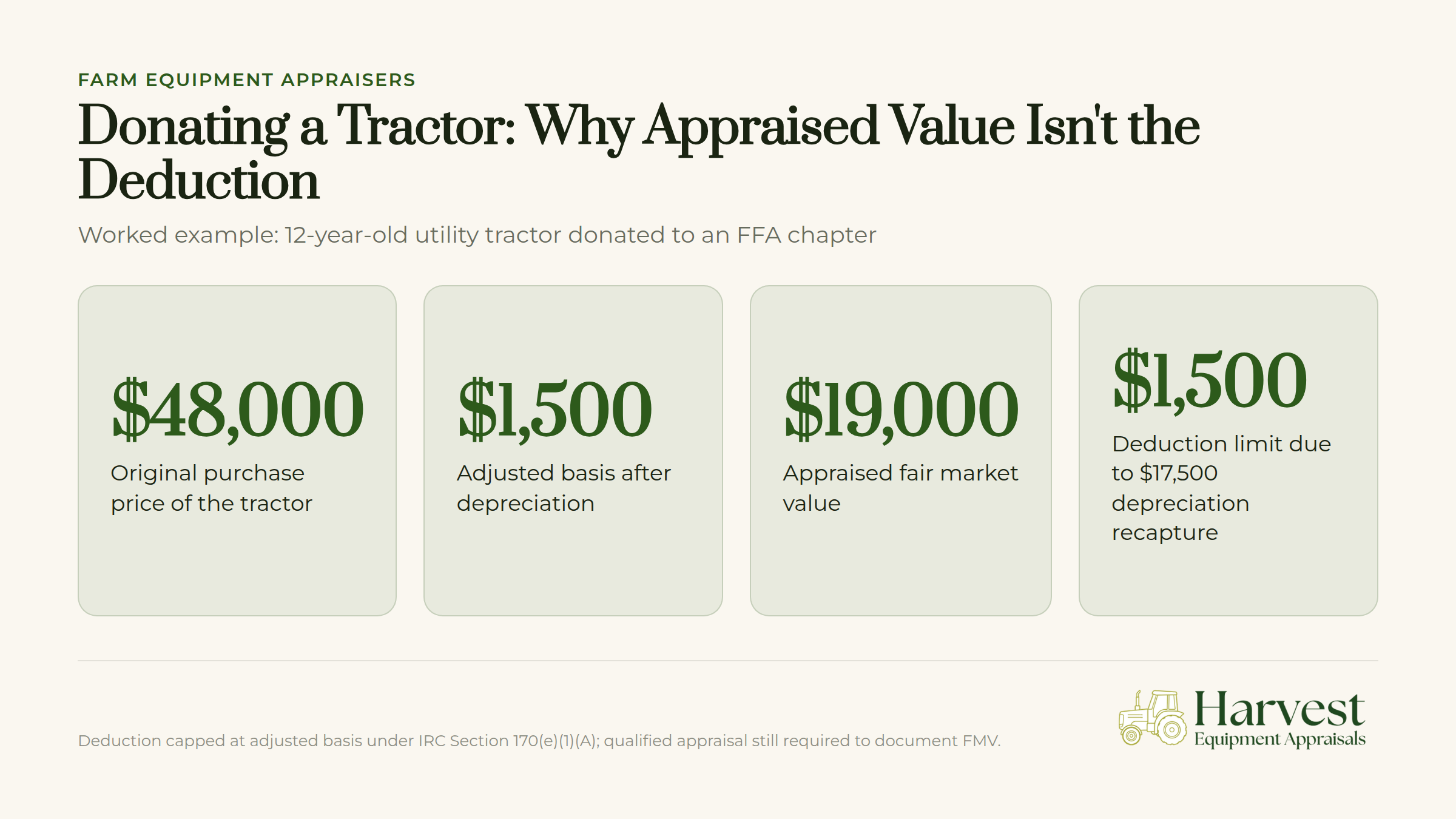
Consider a farmer donating a 12-year-old utility tractor to a local FFA chapter for use in its agricultural mechanics program.
| Item | Amount |
|---|---|
| Original purchase price | $48,000 |
| Accumulated depreciation claimed | $46,500 |
| Adjusted basis | $1,500 |
| Appraised fair market value | $19,000 |
| Potential depreciation recapture if sold | $17,500 |
Because the tractor is fully depreciated business equipment and selling it would have triggered $17,500 of ordinary income through depreciation recapture, Section 170(e)(1)(A) generally limits the deduction to the $1,500 adjusted basis, not the $19,000 appraised value. The qualified appraisal still matters: it documents the $19,000 fair market value for the file, supports the donee's records, and gives the CPA the number needed to run the basis calculation correctly. Without it, there's no defensible starting point for the deduction analysis at all.
What a Farm Equipment Donation Appraisal Includes
A proper donation appraisal documents the equipment's condition, hours or usage, comparable market sales, and the valuation methodology used to reach fair market value, all presented in the format the IRS requires for Section B. For farm equipment, our appraisals are quoted as a fixed fee once we understand the equipment and the intended use of the report; an IRS-qualified farm equipment appraisal starts at $395, and engagements are always quoted before work begins rather than billed hourly.
Farmers considering a donation should loop in their CPA early, get the appraisal scheduled within that 60-day window, and keep the signed report on file even for years when it doesn't need to be attached to the return. That combination, a qualified appraiser's fair market value opinion paired with sound tax guidance on basis and recapture, is what keeps a generous donation from turning into an IRS headache later.
This article is provided for general informational purposes only and does not constitute legal, tax, or financial advice. Readers should consult a qualified attorney or CPA regarding their specific circumstances.