
Blog
Farm Equipment Fleet Appraisal: Valuing Every Machine for Estate, Insurance, or Sale
A farm equipment fleet appraisal values every tractor, implement, and trailer on an operation individually before rolling those figures into one defensible total. This guide walks through the item-by-item process and shows how the numbers work for estate settlement, insurance, and sale or loan use.
A working farm rarely owns just one machine worth appraising. Between tractors, a combine, planters, tillage tools, sprayers, trailers, and livestock handling equipment, most operations carry a fleet, and valuing that fleet correctly means more than adding up guesses on a spreadsheet. A proper farm equipment fleet appraisal treats each machine as its own subject, develops a supportable value for it, and then rolls every figure into a schedule that a court, insurer, or lender can actually use.
We build these reports for three recurring situations: settling an estate, scheduling insurance coverage, and supporting a sale or loan application. Our farm equipment appraisal team approaches each the same way at the item level, then formats the final report around what that particular use requires. If you're working through probate, our farm equipment appraisal for probate guide covers the estate side in more depth, and if the fleet is collateral for a loan, our farm equipment appraisal for loans page walks through what lenders expect to see.
What Sets a Fleet Appraisal Apart From a Single-Machine Appraisal
A single-machine appraisal answers one question: what is this tractor worth? A fleet appraisal has to answer that question a dozen or fifty times over, then explain how those answers relate to each other and to the whole.
The complexity isn't just volume. A fleet typically mixes equipment types that behave very differently in the market: a late-model tractor holds value on a fairly liquid used market, while a specialized implement or an older grain cart may have a thinner pool of comparable sales. Appraising the group requires the appraiser to stay familiar with each equipment category's own market, not apply one blanket assumption across everything on the yard.
This is also where premise of value matters more than people expect. A fleet appraised at fair market value for an estate may carry different figures than the same fleet appraised at orderly liquidation value for a forced sale, because the two premises assume different selling conditions and timeframes. Getting the premise right at the outset keeps every item in the schedule internally consistent.
How We Identify, Group, and Value Each Machine in the Fleet
We start every fleet engagement the same way regardless of its intended use: full identification of every asset before a single value is developed. Skipping this step is the most common way a fleet appraisal ends up unreliable.
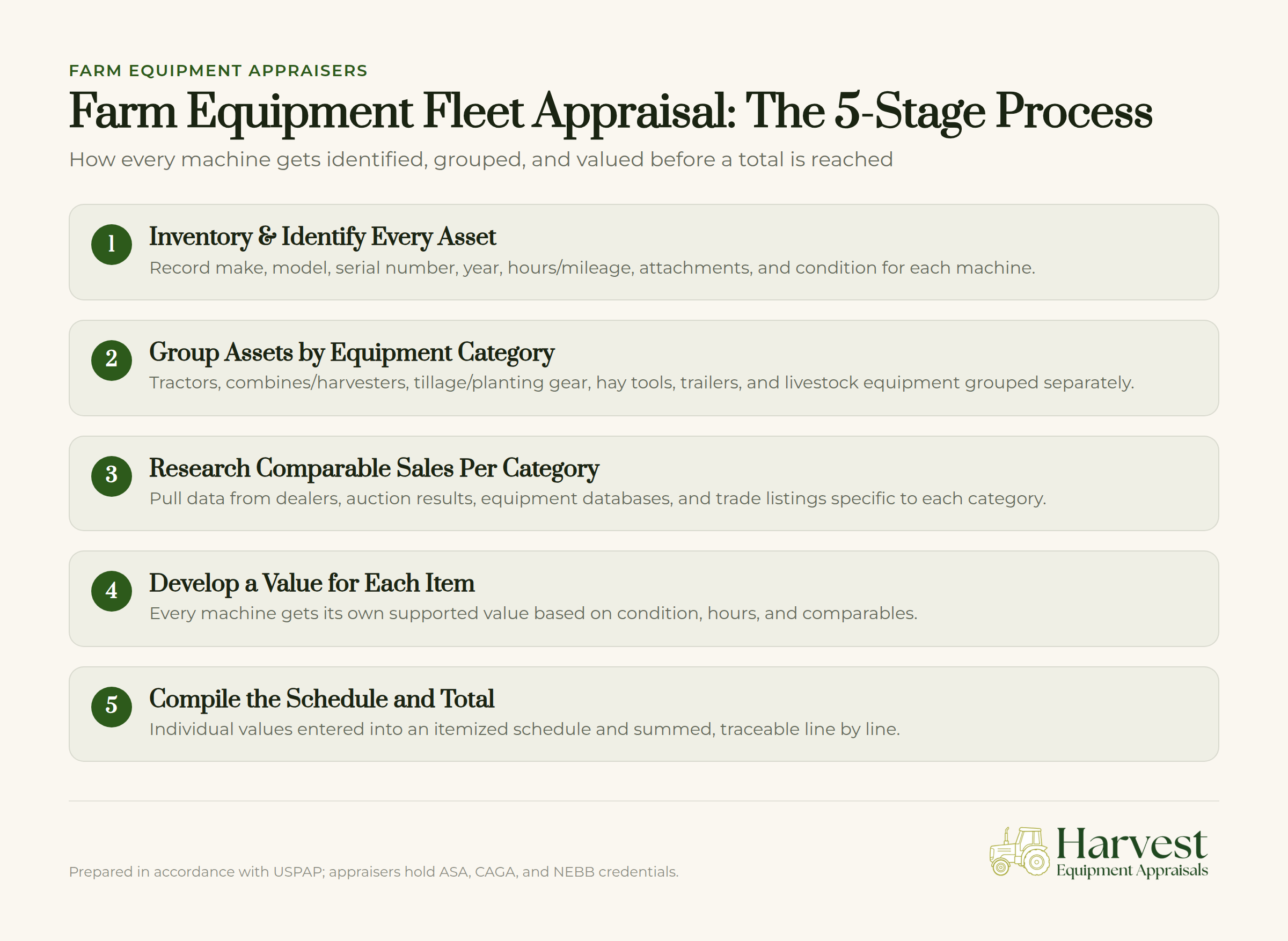
The process generally follows five stages:
- Inventory and Identify Every Asset
- We record make, model, serial number, year, hours or mileage, attachments, and observed condition for every machine and implement on the property.
- Group Assets by Equipment Category
- Tractors, combines and harvesters, tillage and planting equipment, hay and forage tools, trailers, and livestock handling gear each get grouped separately, since each category trades in a different segment of the used equipment market.
- Research Comparable Sales for Each Category
- We pull data from used equipment dealers, auction results, equipment databases, and trade publication listings specific to each category, rather than applying one generic depreciation curve across the whole fleet.
- Develop a Value for Each Item
- Every machine gets its own supported value based on its actual condition, hours, and comparable sales, adjusted individually rather than as a percentage of some other item's number.
- Compile the Schedule and Total
- Individual values are entered into an itemized schedule and summed to a total fleet value, with the math traceable line by line.
Our appraisers hold credentials with organizations that set the standards behind this process, including the ASA, CAGA, and NEBB, and every fleet report is prepared in accordance with USPAP (the Uniform Standards of Professional Appraisal Practice). USPAP does not mandate a specific report format, but it does require enough detail about each item for the intended user to understand exactly what was appraised and how the value was reached, which is precisely why a fleet report can never skip straight to a lump total.
Rolling Item Values Into a Fleet Schedule and Total
The schedule is where the item-by-item work becomes usable. Each row lists the asset, its identifying details, its condition, and its individual value; the bottom line sums everything into a single fleet figure the client can hand to an attorney, an insurer, or a lender.
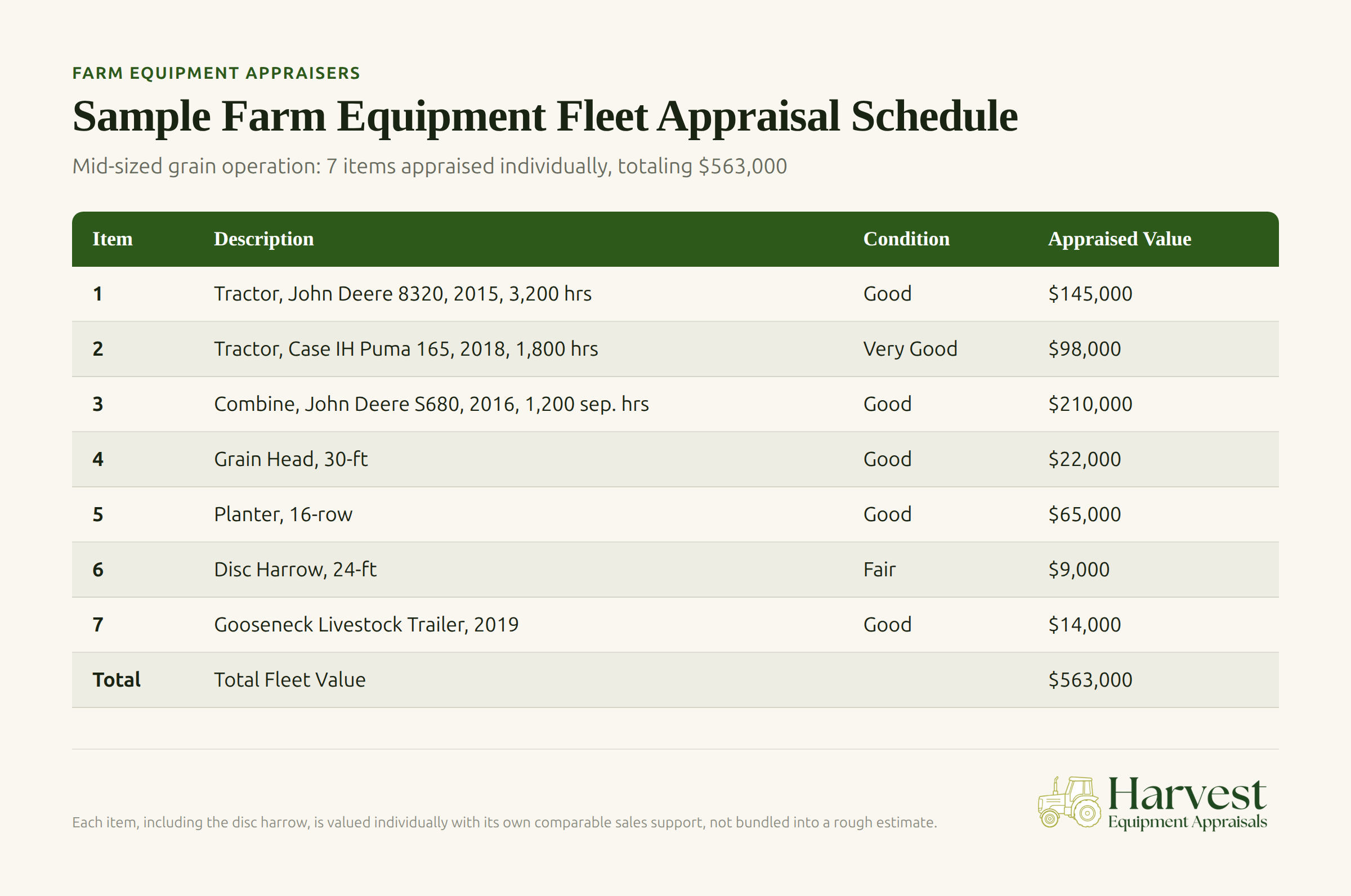
Example: Consider a mid-sized grain operation with two tractors, a combine, a grain head, a planter, a disc, and a livestock trailer. A fleet schedule for that operation might look like this:
| Item | Description | Condition | Appraised Value |
|---|---|---|---|
| 1 | Tractor, John Deere 8320, 2015, 3,200 hrs | Good | $145,000 |
| 2 | Tractor, Case IH Puma 165, 2018, 1,800 hrs | Very Good | $98,000 |
| 3 | Combine, John Deere S680, 2016, 1,200 sep. hrs | Good | $210,000 |
| 4 | Grain Head, 30-ft | Good | $22,000 |
| 5 | Planter, 16-row | Good | $65,000 |
| 6 | Disc Harrow, 24-ft | Fair | $9,000 |
| 7 | Gooseneck Livestock Trailer, 2019 | Good | $14,000 |
| Total Fleet Value | $563,000 |
Notice that the disc harrow, valued in fair condition at $9,000, does not get bundled into a rough "implements" line item worth some estimated chunk of the total. It stands on its own, supported by its own comparable sales, exactly like the $210,000 combine. That's what separates a defensible fleet appraisal from an informal walk-around estimate.
Why the Itemized Detail Matters as Much as the Total
Key takeaway: A fleet total is only as reliable as the item-level work behind it, and each of the three main uses for a fleet appraisal (estate, insurance, sale or financing) depends on that itemization in a different way.
Estate Settlement and IRS Form 706
When farm machinery passes through an estate, it generally has to be reported on IRS Form 706, Schedule F, and that schedule calls for property to be itemized rather than lumped into a single "farm equipment" line (see IRS.gov for current filing guidance). An executor who reports one combined figure risks a Schedule F that doesn't hold up to scrutiny from the IRS or from co-heirs who want to see how the total was built.
Our farm equipment appraisal for probate work always produces the item-by-item schedule first, with the estate total presented as a summary of that detail rather than a standalone number.
Insurance Scheduling
Insurers who write scheduled coverage for farm machinery want to know exactly what they're insuring and at what value, item by item. If a single implement is damaged or stolen, the claim gets settled against that item's own scheduled value, not against a share of an undifferentiated fleet total. An itemized appraisal gives both the policyholder and the carrier a defensible reference point before a loss ever happens.
Sale and Financing
A buyer negotiating for an entire fleet, or a lender underwriting equipment as collateral, wants to see what's driving the number. A lender in particular needs to understand which machines carry the bulk of the collateral value and which are marginal, since that shapes how the loan is structured. Our farm equipment appraisal for loans reports are built with that underwriting use in mind from the start.
What a Whole-Fleet Appraisal Costs
Fleet appraisal fees are quoted as a fixed fee before any work begins, scoped to the number of items in the fleet, the mix of equipment categories, the completeness of existing records, and whether the report needs to meet IRS-qualified standards or a standard reporting format. Fees are never based on the value of the equipment itself; a $500,000 fleet in excellent condition doesn't cost more to appraise than a comparable fleet with lower market values, since it's the scope of work, not the dollar figure at the end, that determines the fee.
For context, our published farm equipment pricing starts at $295 for a standard single-item report and $395 for an IRS-qualified report, with typical single-item engagements running $695 to $2,200 depending on complexity. A full fleet appraisal covering a dozen or more machines across multiple equipment categories, with the itemized detail needed for an estate or lender, generally falls into the $5,000 to $10,000-plus range we publish for our most complex machinery and equipment engagements. You can review current pricing for individual asset types before requesting a fleet-level quote.
Getting a Fleet Value That Holds Up Wherever You Need It
A whole-farm equipment fleet doesn't need a rough estimate scribbled on a legal pad; it needs the same rigor applied to a single tractor, repeated across every machine on the operation, and then summarized into one number that traces back to real support. That's true whether the report ends up attached to a Schedule F, a proof-of-loss form, or a loan file. Our appraisers build that schedule from the ground up so the total you're handed is one you, your attorney, your insurer, or your lender can trust.
This article is provided for general informational purposes only and does not constitute legal, tax, or financial advice. Readers should consult a qualified attorney or CPA regarding their specific circumstances.