
Blog
How to Complete IRS Form 8283 for a Farm Equipment Donation Over $5,000
IRS Form 8283 requires three signatures, a qualified appraisal, and precise line-by-line documentation once a farm equipment donation's claimed deduction exceeds $5,000. This guide walks through Section B part by part, from describing the tractor or combine to the appraiser's declaration and the donee's acknowledgment of receipt.
Donating a tractor, combine, or baler to an FFA chapter, county fairground, or land-grant university feels straightforward until the paperwork lands on your desk. Once the claimed deduction for that equipment exceeds $5,000, the IRS expects a specific form, a specific appraisal, and three separate signatures before your deduction is safe. This guide walks through IRS Form 8283 line by line, focused on what farm equipment donors actually need to know, drawing on our appraisers' work valuing tractors, combines, and implements for farm equipment appraisal engagements nationwide.
When Do You Need Form 8283 for a Farm Equipment Donation?
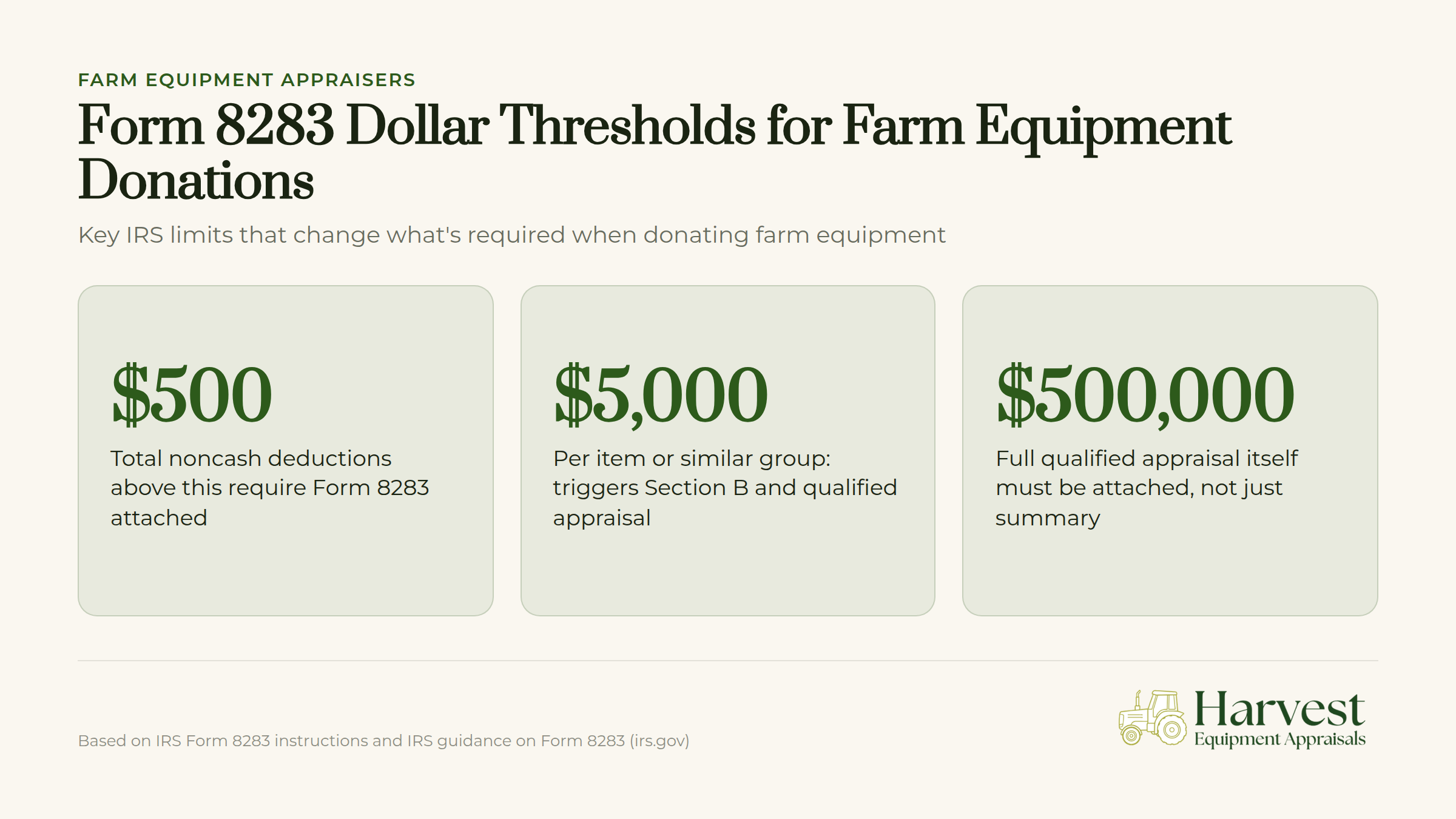
You must attach Form 8283 to your return once your total noncash charitable deductions for the year exceed $500. Farm equipment, being tangible personal property rather than cash, falls squarely within that rule.
The thresholds that matter most for equipment donors are these:
- Over $500 total: Form 8283 must be attached to the return.
- Over $5,000 for a single item or group of similar items: Section B applies, and a qualified appraisal is generally required, according to the IRS Form 8283 instructions.
- Over $500,000: the full qualified appraisal itself, not just the summary form, generally must be attached to the return, per the IRS's guidance on Form 8283.
That $5,000 threshold is measured per item or per group of similar items, not per donation event. Donating a used tractor worth $8,000 alone triggers Section B. So does donating three implements worth $2,000 each to the same organization in the same tax year, since together they exceed $5,000 as a group of similar items.
Section A vs. Section B: Which Applies to Your Tractor or Combine?
Section A covers noncash donations where the claimed deduction for an item or group falls between $500 and $5,000. It asks for basic information: the donee organization, a description of the property, the contribution date, and fair market value, but it does not require a qualified appraisal.
Section B is where most farm equipment donations end up, because a working tractor, combine, or baler is rarely worth less than $5,000. If you're weighing whether a particular gift crosses that line, our guide to farm equipment donation appraisal rules covers the aggregation rules and IRS documentation requirements in more depth.
Section B, Part I: Describing the Donated Equipment
Part I is completed by the donor and asks for the specifics of the equipment itself. For a typical piece of farm machinery, you'll provide:
- Description of the property: make, model, year, and condition, such as "2015 Case IH Magnum 250, 4,200 hours, good working order."
- Date of contribution: the date the receiving organization actually took possession of the equipment.
- Date acquired by the donor: when you originally purchased or otherwise obtained the machine.
- How the property was acquired: typically "purchased" for farm equipment, though trade-ins and inherited equipment are handled differently.
- Cost or adjusted basis: your original cost less any depreciation already claimed, which matters more than most donors expect (more on that below).
This section is the donor's responsibility alone. The appraiser does not fill in acquisition history or basis; that information comes from your own purchase and depreciation records.
Section B, Part II: Partial Interests (Rarely Relevant to Equipment)
Part II addresses donations of partial or fractional interests in property, along with certain restricted gifts. For most farm equipment donations, where the donor transfers full, complete ownership of the tractor or combine to the charity, this section simply does not apply. It becomes relevant only in the unusual case of donating an undivided partial interest in a piece of machinery, such as shared ownership between family members who each donate their share.
The Three Required Signatures: Parts III, IV, and V
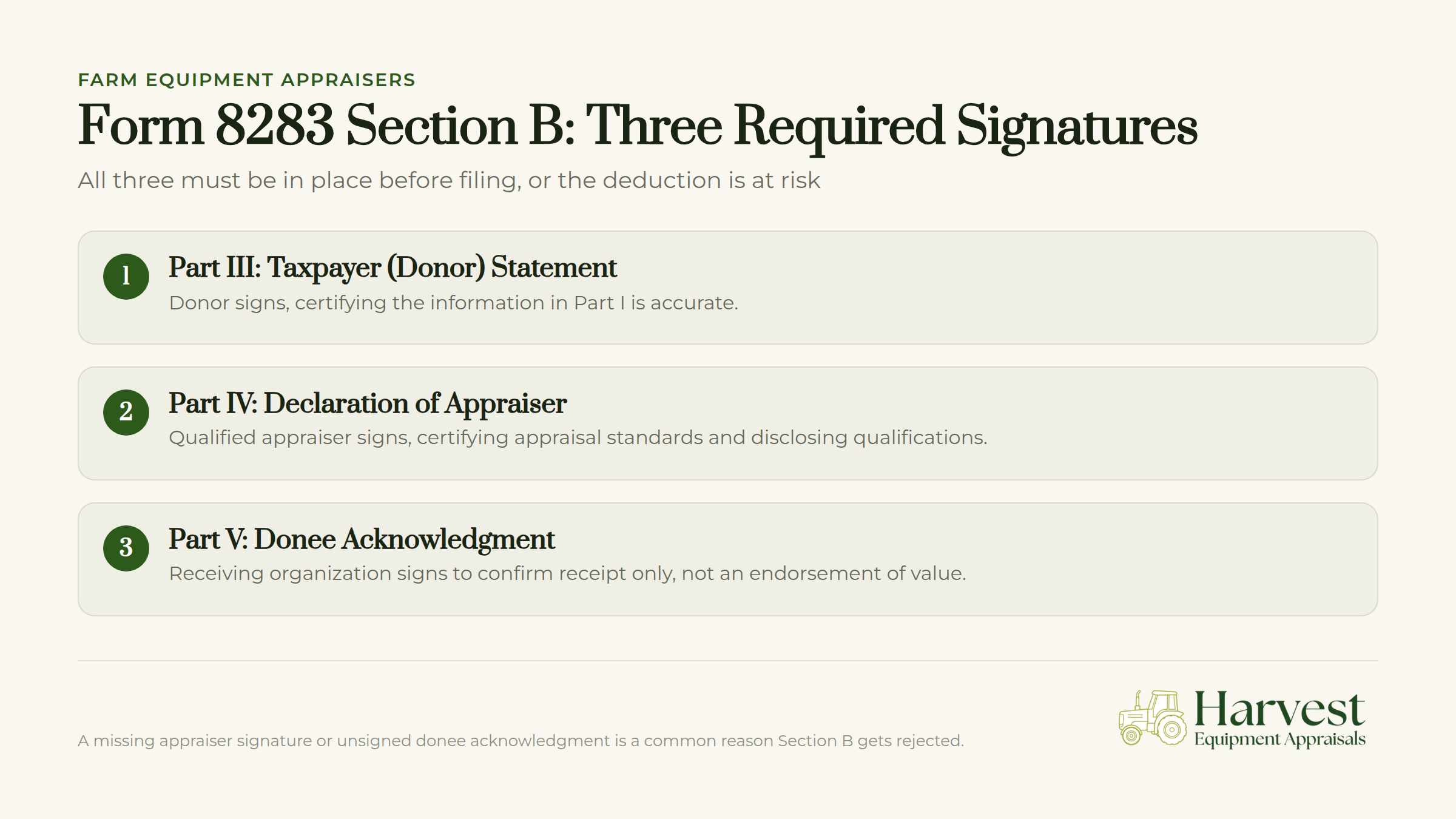
Section B requires three separate signatures before it's complete, and missing any one of them puts the deduction at risk.
- Part III: Taxpayer (Donor) Statement. You, the donor, sign here certifying the information reported in Part I is accurate.
- Part IV: Declaration of Appraiser. The qualified appraiser who valued the equipment signs here, certifying the appraisal meets the required standards and disclosing their qualifications.
- Part V: Donee Acknowledgment. A representative of the receiving organization signs to confirm the equipment was received. This signature confirms receipt only; it is not an endorsement of the appraised value.
All three signatures need to be in place before the form is filed. A missing appraiser signature or an unsigned donee acknowledgment is one of the most common reasons Section B gets kicked back.
Who Qualifies as Your Appraiser (and Who Doesn't)
A qualified appraisal must be made, signed, and dated by a qualified appraiser in accordance with generally accepted appraisal standards, and it must be dated no earlier than 60 days before the contribution date and received before your return's due date, including extensions, under the IRS Form 8283 instructions.
Not just anyone with equipment knowledge qualifies. The IRS excludes several parties from serving as your appraiser:
- The donor cannot appraise their own donated equipment.
- The donee organization receiving the equipment cannot serve as the appraiser.
- A party to the transaction used to acquire the equipment is excluded, unless the equipment was acquired and donated within 2 months of purchase at no more than the acquisition price.
- An employee of any of the above excluded parties is also disqualified.
The appraiser's fee also cannot be based on a percentage of the appraised value. That's a standards violation, not just an IRS technicality, and it's one reason our appraisers always quote a fixed fee before beginning any farm equipment engagement.
Watch out: Hiring the equipment dealer who sold you the tractor, or asking the receiving charity's board member who happens to know machinery, are both common shortcuts that disqualify the appraisal entirely.
Worked Example: Donating a Used Combine to an FFA Chapter
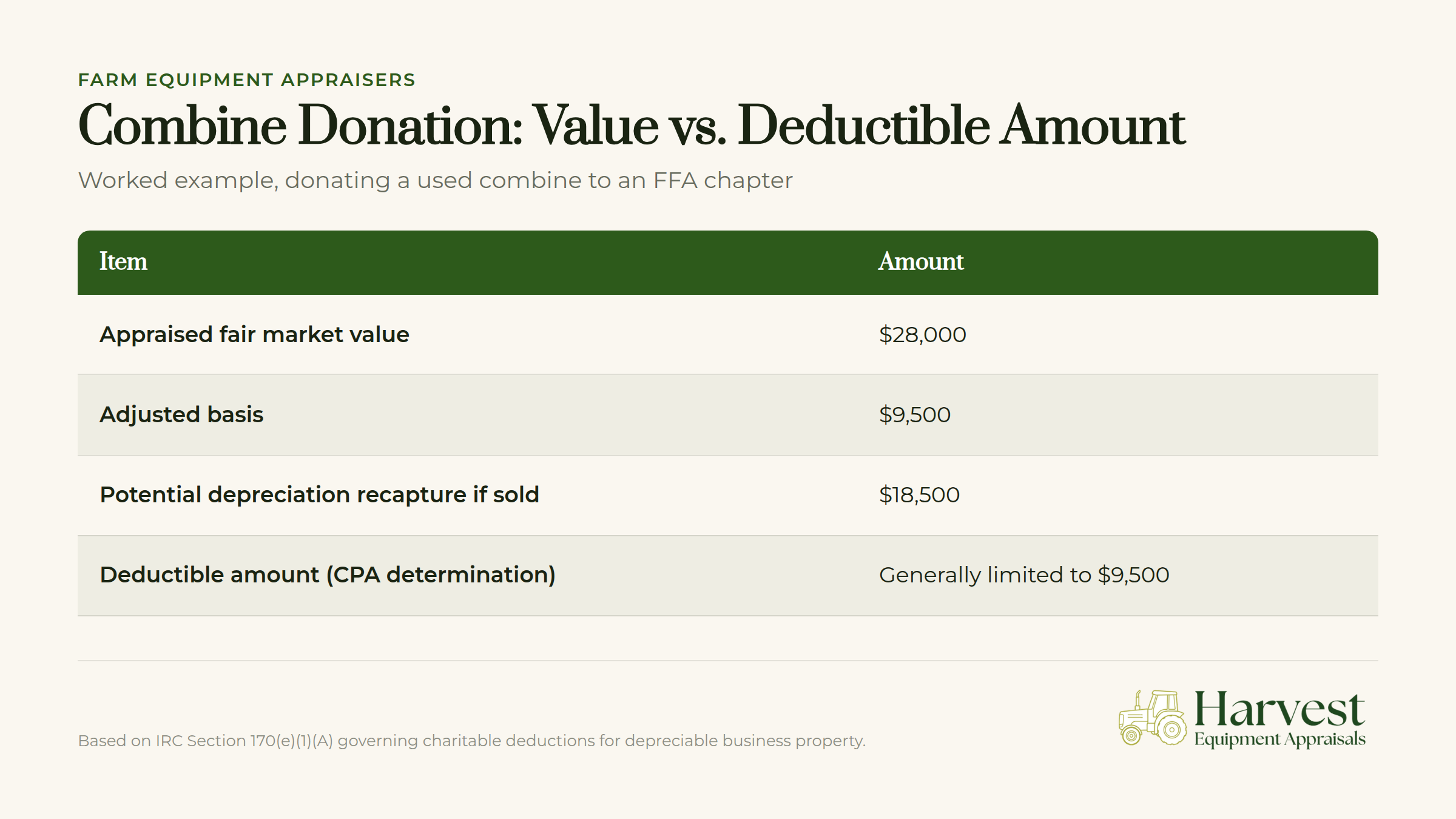
Here's how the numbers typically play out. Suppose a farmer purchased a combine for $45,000 several years ago and has since claimed substantial depreciation, bringing the adjusted basis down to $9,500. The farmer donates the combine to a local FFA chapter, and a qualified appraiser determines its fair market value at $28,000.
| Item | Amount |
|---|---|
| Appraised fair market value | $28,000 |
| Adjusted basis | $9,500 |
| Potential depreciation recapture if sold | $18,500 |
| Deductible amount (CPA determination) | Generally limited to $9,500 |
The appraiser's job stops at the $28,000 fair market value figure. Whether the donor can actually deduct that full amount is a separate question for a CPA, because farm equipment is depreciable business property. Under IRC Section 170(e)(1)(A), when donated property would have produced ordinary income through depreciation recapture if it had been sold instead of donated, the charitable deduction is reduced by that recapture amount. In practice, that often caps the deduction much closer to adjusted basis than to fair market value.
If the Charity Sells the Equipment Within Three Years
If the donee organization sells, trades, or otherwise disposes of the donated equipment within 3 years of receiving it, the organization generally must file Form 8282, Donee Information Return, and send a copy to the donor, as outlined in the IRS's guidance for charities on substantiating noncash contributions. This filing lets the IRS compare the sale price to the appraised value reported on Form 8283.
Donors don't control what a charity does with a tractor after the gift, but it's worth knowing that a quick resale at a price far below the appraised value can draw scrutiny. This is one more reason the appraisal needs to reflect a defensible, well-supported fair market value rather than an optimistic number.
What Happens If You Get Section B Wrong
Failing to fully complete Section B, or filing Form 8283 without all three required signatures, can result in the entire deduction being disallowed. The IRS does allow an exception when the failure was due to reasonable cause and not willful neglect, but that's a narrow defense you don't want to rely on.
Key takeaway: A complete, properly signed Form 8283 with a qualified appraisal attached (or referenced, if the deduction exceeds $500,000) is the difference between a deduction that holds up and one that gets challenged.
Getting the Appraisal Right the First Time
A farm equipment donation appraisal has to stand on its own: an independent, qualified appraiser, a defensible fair market value, and a report that matches every line Section B asks for. Our appraisers prepare these reports for tractors, combines, balers, and full equipment lines donated to schools, fire departments, and agricultural programs across the country. If you're planning a donation and need a qualified appraisal that satisfies the IRS's Section B requirements, you can request an appraisal and we'll scope the assignment before any work begins.
This article is provided for general informational purposes only and does not constitute legal, tax, or financial advice. Readers should consult a qualified attorney or CPA regarding their specific circumstances.