
Blog
How to Read a Used Tractor Value Guide: Dealer Quotes, Auctions, and Appraisals
A used tractor value guide, a dealer trade-in quote, and an auction result can each give you a different number for the same machine. This guide explains what each source actually measures and when you need a formal appraisal instead.
If you have already run your tractor's make, model, and hours through an online value guide, you have probably noticed the number it gave you does not match the trade-in offer from your dealer or the sale price you saw at a recent auction. That is not a glitch. Each of those sources measures something different, built on different assumptions about condition, sale terms, and who is paying whom. This guide walks through what a used tractor value guide actually tells you, how to read dealer quotes and auction results without being misled by them, and when the situation calls for a formal, USPAP-compliant appraisal instead.
What a Free Tractor Value Guide Actually Tells You
A free online value guide or listings site is a market reference, not a verified sale price. It compiles asking prices and modeled estimates for a given make, model, year, and hour range, and it rarely confirms whether any of those listed tractors actually sold at the price shown. The widely cited process for using a guide like Kelley Blue Book's tractor tool involves entering the model and condition and receiving an estimated range, but that range is built from listed and reported values rather than closed transactions, and it still requires the user to judge how their specific tractor compares to the data behind it, as described in general consumer guidance on tractor valuation tools.
If you have already spent time on our tractor value FAQ page, you have seen the basics of what these guides need from you: model, year, hours, and condition. What they cannot account for is everything a guide can't see from a web form: documented maintenance history, a cracked block that was welded and repainted, a loader that was swapped off another machine, or a PTO that slips under load. A guide number is a starting point for a conversation, not a concluded value.
Pro tip: Before you trust a guide figure, check whether it labels itself as retail, private-party, or wholesale value. Those three labels can produce meaningfully different numbers for the identical tractor, and a guide that does not specify which one it is using is giving you an incomplete answer.
Reading a Dealer Trade-In Quote for What It Is
A dealer trade-in quote is not a neutral opinion of your tractor's value. It is an offer shaped by the dealer's own resale risk, the cost of reconditioning before the unit goes back on the lot, floor-plan financing expenses, and the margin the dealer needs to make the deal worthwhile.
That structure makes trade-in numbers intentionally conservative. A dealer who offers $28,000 on a tractor is not telling you the tractor is worth $28,000 on the open market; they are telling you what they can pay and still resell it profitably after cleaning it up, replacing worn tires, and carrying it on their lot for a few months. The gap between a trade-in offer and a retail listing for a similar tractor often reflects exactly those costs, not a disagreement about the machine's condition.
Example: A dealer might list a comparable tractor at $34,000 retail while offering you $27,500 in trade. The $6,500 difference typically covers reconditioning, the dealer's carrying cost while the unit sits in inventory, and profit margin, not a flaw specific to your tractor.
Watch out: A trade-in quote is also a negotiating opening tied to the deal you're making on a new or replacement unit. If you are not buying something from that dealer, their trade-in number tells you very little about what your tractor would bring in a straight private-party or auction sale.
Auction Results Are Real Sales, But They Still Need Adjusting
An auction result is a completed transaction, which makes it stronger evidence than an asking price or a guide estimate. But a single hammer price still needs adjustment before you can use it as a stand-in for your tractor's value.
Industry guidance on used equipment pricing consistently stresses comparing auction results by age, condition, and specification rather than treating any single sale, or an auction average, as a universal number, since results shift with the specific units and markets being compared. Before leaning on an auction price, account for:
- Buyer's premium and fees: The posted hammer price is often reported before the buyer's premium, taxes, and transport costs are added, so the all-in cost to the buyer is higher than the headline number.
- Sale conditions: An orderly auction with normal marketing time produces different results than a forced or distressed liquidation where sellers had no leverage to wait for a better bid.
- Condition at time of sale: "As-is, where-is" terms mean the buyer absorbed unknown risk, which can depress or inflate the price depending on how the bidder pool perceived that risk.
- Geography and season: Regional demand and the time of year both move tractor prices, and a sale in one state during planting season is not automatically comparable to a sale in another region during the off-season, a pattern documented in market tracking of used tractor price trends.
Key takeaway: An auction result tells you what one buyer paid for one tractor, under one set of sale conditions, on one day. It is useful evidence, but it needs the same kind of adjustment a guide number needs before it can stand in for your tractor's value.
Three Sources, One Question: What Is This Tractor Actually Worth?
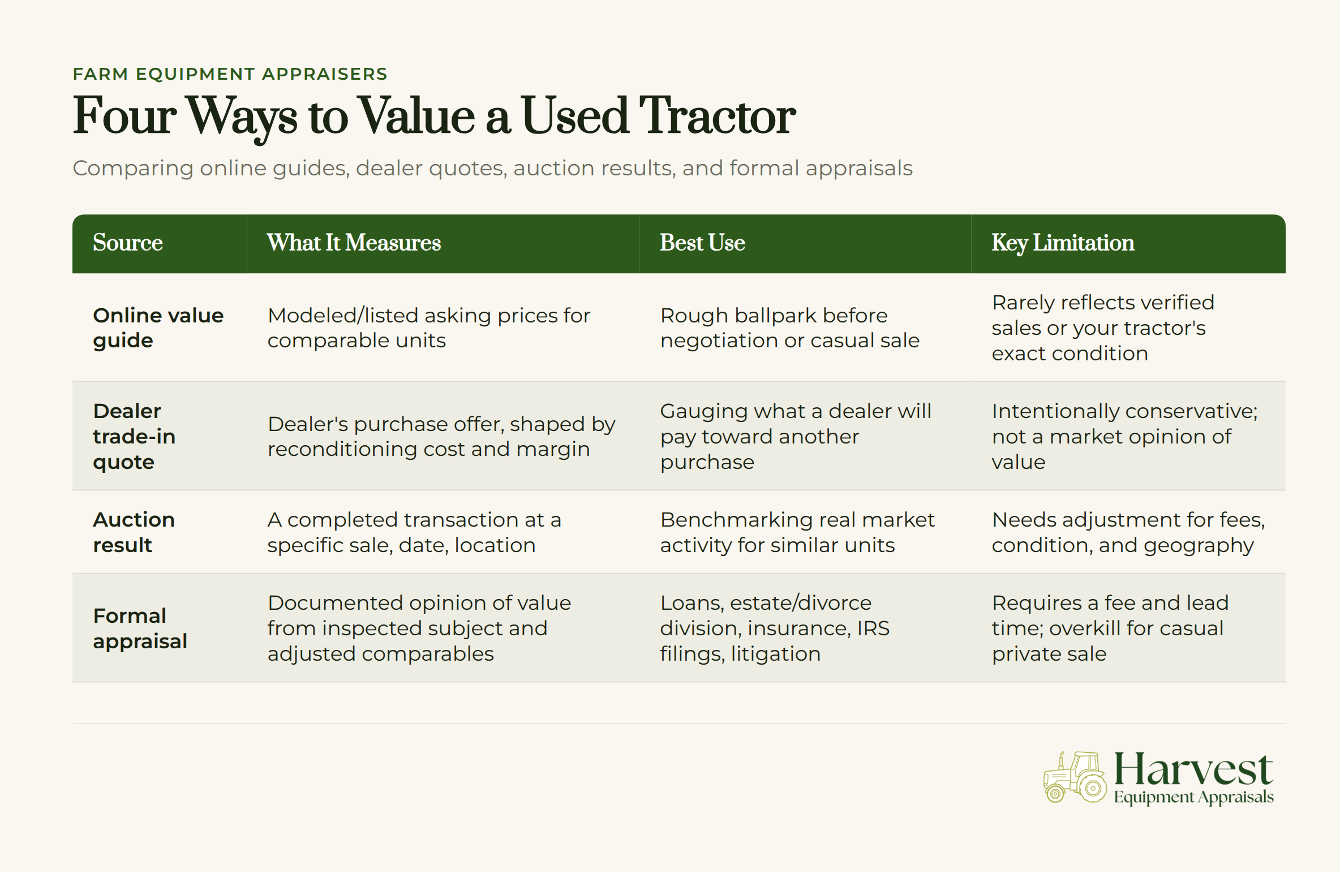
The table below lays out what each informal source measures, where it is genuinely useful, and where it falls short, alongside what a formal appraisal adds.
| Source | What it measures | Best use | Key limitation |
|---|---|---|---|
| Online value guide | Modeled or listed asking prices for comparable makes, models, and hour ranges | Rough ballpark before a negotiation or casual sale | Rarely reflects verified closed sales or your tractor's specific condition and configuration |
| Dealer trade-in quote | A dealer's purchase offer, shaped by reconditioning cost, floor-plan financing, and margin | Gauging what a dealer will pay toward another purchase | Intentionally conservative; not a market opinion of value |
| Auction result | A completed transaction at a specific sale, date, and location | Benchmarking real market activity for similar units | Needs adjustment for fees, sale conditions, condition, and geography before it applies to your tractor |
| Formal appraisal | A documented opinion of value under a defined premise, built on an inspected subject and adjusted comparables | Loan collateral, estate and divorce division, insurance claims, IRS donation filings, litigation | Requires a fee and lead time; not needed for a casual private sale |
When a Guide Number Isn't Enough: What a Formal Appraisal Adds
A formal equipment appraisal differs from every informal source above in four specific ways. First, it defines a value premise: fair market value, orderly liquidation value, forced liquidation value, or trade-in value are not interchangeable, and the premise selected changes the number. Second, it identifies the exact subject tractor by serial number, documented hours, and configuration, rather than a general make and model range. Third, it applies the sales comparison approach with documented, explained adjustments for each difference between your tractor and the comparables, and considers the cost and income approaches where appropriate, consistent with methodology recognized across machinery and equipment valuation practice, as outlined in general industry guidance on machinery and equipment valuation. Fourth, it produces a written report that states the assumptions, limiting conditions, and effective date, so a lender, court, insurer, or the IRS can review exactly how the appraiser reached the number.
Our tractor appraisal services are prepared in accordance with USPAP, the standards published by The Appraisal Foundation. Our appraisers hold credentials with organizations including the American Society of Appraisers (ASA) and the National Equipment and Business Builders Association's Certified Machinery and Equipment Appraiser (CMEA) designation, which are the relevant credentialing bodies for machinery and equipment valuation work.
Engagements are quoted as a fixed fee after we scope the assignment, based on factors like the number of tractors or implements involved, the depth of analysis required, and whether the report must be IRS-qualified. We never bill by the hour, and the fee reflects the complexity of the assignment, not the value of the tractor itself.
Do You Need a Guide, a Quote, or an Appraisal?
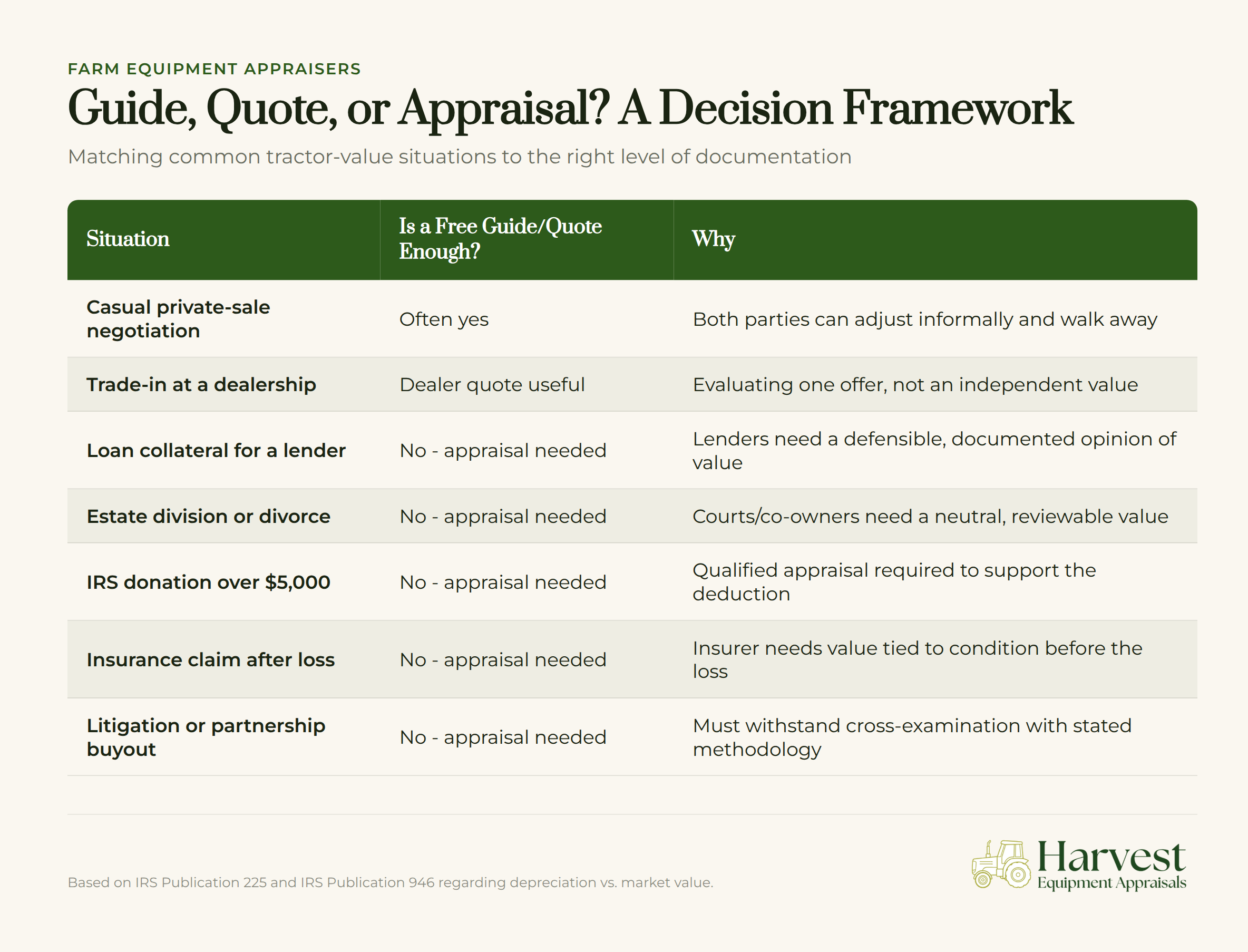
The right source depends entirely on what the number needs to hold up to. The table below maps common situations to the tool that actually fits.
| Situation | Is a free guide or quote enough? | Why |
|---|---|---|
| Casual private-sale negotiation | Often yes | Both parties can adjust informally and walk away if the price doesn't work |
| Deciding whether to trade in at a dealership | Dealer quote is useful context | You're evaluating one specific offer, not establishing an independent value |
| Loan collateral for a lender | No, appraisal needed | Lenders generally require a defensible, documented opinion of value tied to a specific premise |
| Estate division or divorce settlement | No, appraisal needed | Courts and co-owners need a neutral, reviewable value they did not produce themselves |
| IRS charitable donation over $5,000 | No, appraisal needed | A qualified appraisal is generally required to support the deduction, separate from any market guide figure |
| Insurance claim after loss or damage | No, appraisal needed | Insurers need a documented value tied to the specific tractor's condition and configuration before the loss |
| Litigation or partnership buyout | No, appraisal needed | A report that can be reviewed and defended under cross-examination requires stated methodology and assumptions |
One more point worth separating out clearly: depreciation figures from your tax return are not market values. IRS guidance on farm asset depreciation describes recovery periods and adjusted basis calculations for tax purposes, and that accounting basis can diverge sharply from what a tractor would actually bring in a sale, as explained in IRS Publication 225 and IRS Publication 946. A nearly fully depreciated tractor can still carry real resale value, and a recently purchased one can be worth less than its remaining tax basis. Don't plug a depreciation schedule into a value guide and expect a market answer.
Get a Defensible Number When the Guide Isn't Enough
A used tractor value guide, a dealer quote, and an auction result all have a place in figuring out what a tractor might bring. None of them were built to withstand review by a lender, a court, a co-owner's attorney, or the IRS. When the number needs to hold up under that kind of scrutiny, a formal appraisal with a stated value premise, a documented subject, and adjusted comparable sales is the tool built for the job.
If you're facing a loan application, an estate or divorce settlement, an insurance claim, or a donation filing, request an appraisal and our team will scope the assignment and quote a fixed fee before any work begins.
This article is provided for general informational purposes only and does not constitute legal, tax, or financial advice. Readers should consult a qualified attorney or CPA regarding their specific circumstances.