
Blog
Retail vs. Orderly Liquidation vs. Forced Sale Value: Which One Applies to Your Farm Equipment
Orderly liquidation value for farm equipment sits between fair market value and forced sale value, and which premise your tractor or combine gets appraised under depends entirely on why the appraisal is needed. This guide breaks down all four value premises so you know which number actually applies to your situation.
A tractor sitting in the same shed can carry four different appraised values depending on why someone needs the number. That is not sloppy appraisal work. It is how professional valuation is supposed to function. The intended use of the appraisal, not the appraiser's preference, determines which value premise gets applied, and understanding the four premises helps you make sense of numbers that might otherwise look inconsistent.
This matters most often for farmers and their advisors working through a tractor appraisal, a lender collateral review, an estate settlement, or a bankruptcy filing, because the same combine can legitimately appraise differently across each of those scenarios. Below is a plain explanation of fair market value, retail replacement value, orderly liquidation value, and forced liquidation value, and how appraisers decide which one belongs on your report.
Fair Market Value: The Willing Buyer, Willing Seller Standard
Fair market value (FMV) is the price a knowledgeable buyer and a knowledgeable seller would agree to when neither party is under any pressure to complete the deal. Both sides have reasonable knowledge of relevant facts, the transaction is in cash or cash-equivalent terms, and the asset has been given a normal, adequate period of market exposure. This is the value premise most personal property and equipment appraisers are trained to apply as the default standard, consistent with the framework used across the American Society of Appraisers and the International Society of Appraisers.
FMV is the premise most often called for in these scenarios:
- Estate settlement and probate, where the court needs a value that reflects what heirs' inherited equipment is genuinely worth, not a distress number
- Equitable distribution in divorce, where neither spouse is compelled to sell under pressure
- Charitable donation reporting, where the IRS requires a value reflecting normal market conditions
- Gift and estate tax filings, where the standard of value is explicitly defined around the willing buyer, willing seller test
Because FMV assumes no compulsion on either side, it typically sits at the top of the value range for a given piece of equipment. A farm equipment appraisal for probate will almost always be built on this premise, since the estate is not being forced to liquidate machinery under a deadline.
Retail Replacement Value: What It Would Cost to Replace the Equipment
Retail replacement value answers a different question entirely: what would it cost, today, to replace this asset with a similar item purchased at retail? Rather than asking what the equipment would sell for, this premise asks what a buyer would have to pay to acquire an equivalent item through normal retail channels, whether that is a dealer, a private sale, or a comparable used unit on the retail market.
Insurance carriers lean on this premise most heavily. When a combine is destroyed in a fire or a grain bin collapse damages stored implements, the policyholder generally needs to know what it costs to put an equivalent machine back into service, not what the damaged unit would have sold for on the open market. Because retail replacement value is cost-driven rather than sale-driven, it can run higher than fair market value for equipment that has become scarce or is still in active production demand.
Orderly Liquidation Value: Compelled to Sell, but with Time to Market
Orderly liquidation value (OLV) is the gross amount a piece of farm equipment would likely bring in a liquidation sale, given a reasonable, limited period to find a buyer, with the seller compelled to sell on an as-is, where-is basis. Unlike FMV, compulsion is present. Unlike forced liquidation, there is still enough time to market the equipment properly.
Industry practice generally treats a reasonable OLV marketing window as landing somewhere in the range of 60 to 180 days, though the exact period depends on the equipment type and how thin or deep the market is for that asset (EquipmentWatch's overview of orderly liquidation value lays out this middle-ground framing well). During that window, the seller can advertise properly, catalog the inventory, and reach the pool of buyers who actually shop for used tractors, combines, and implements, typically through an organized auction or a negotiated bulk sale rather than a single desperate transaction.
OLV is the premise most commonly requested for:
- Bank and asset-based lending collateral reviews, where the lender needs to know what it could recover if it had to liquidate the equipment in a structured way
- SBA-backed loan underwriting, where lenders size the advance rate against a liquidation-based number rather than retail value
- Chapter 11 reorganization and negotiated Chapter 7 sales, where the trustee has some runway to organize a sale
A farmer applying for equipment financing should expect the appraisal ordered by the bank to come in lower than what the same tractor might fetch in a private retail sale. That gap is not an error; a farm equipment appraisal for loans is built on the OLV premise specifically because it reflects what the lender could realistically recover, not what the farmer could realistically sell for under normal conditions.
Pro tip: If you are shopping the same equipment for both a loan application and an estate filing, expect the two numbers to differ. Ask the appraiser up front which premise the assignment requires, since it changes the analysis, not just the final figure.
Forced Liquidation Value: Compressed Timelines and Severe Compulsion
Forced liquidation value (FLV) is the gross amount typically realized from a properly advertised public auction, with the seller compelled to sell with a sense of immediacy on an as-is, where-is basis. The defining feature is not a specific number of days; it is that proper exposure to the right buyers may not be achievable. A corporate finance industry overview of forced sale value describes it as the estimate realized when assets must be converted to cash on a short timeline due to an unforeseen or uncontrollable event, and equipment-specific sources describe the same dynamic for farm and heavy machinery (Iron Ag's explanation of forced sale value frames it as restricted negotiating flexibility layered on top of a compressed timeline).
FLV shows up in scenarios where the seller has little to no control over timing:
- Bankruptcy trustee fire sales, where equipment must be converted to cash within a court-imposed window
- Foreclosure and repossession, where a lender needs to dispose of collateral quickly
- Court-ordered rapid disposition, where a judge has set a hard deadline
Because buyers know the seller has no leverage, forced liquidation prices are typically the lowest of the four premises, sometimes substantially below fair market value.
Why an Auction Result Is Not Automatically a Forced Liquidation Value
A common misconception is that any auction sale reflects forced liquidation value. It does not. An auction is a method of sale, not a value premise, and the circumstances of a specific auction determine which premise its results actually represent. Farm equipment auctions that are properly advertised well in advance, draw strong attendance, and feature desirable, well-maintained machinery can produce prices that land close to fair market value, or even above it for equipment in high demand.
On the other hand, a poorly advertised auction held on short notice, with thin attendance and a glut of similar equipment on the market that week, can produce results well below fair market value, more consistent with forced liquidation. An independent look at how each individual auction was conducted, its advertising lead time, its buyer turnout, and market conditions at that moment, is required before assuming the sale prices represent any particular value premise.
Watch out: Do not assume that because equipment sold at auction, the result automatically qualifies as a forced liquidation value comparable for your appraisal. A well-marketed farm equipment auction with a deep buyer pool can produce fair-market-level results, and using it as a forced-liquidation comparable would understate the equipment's true value.
Matching the Value Premise to the Intended Use
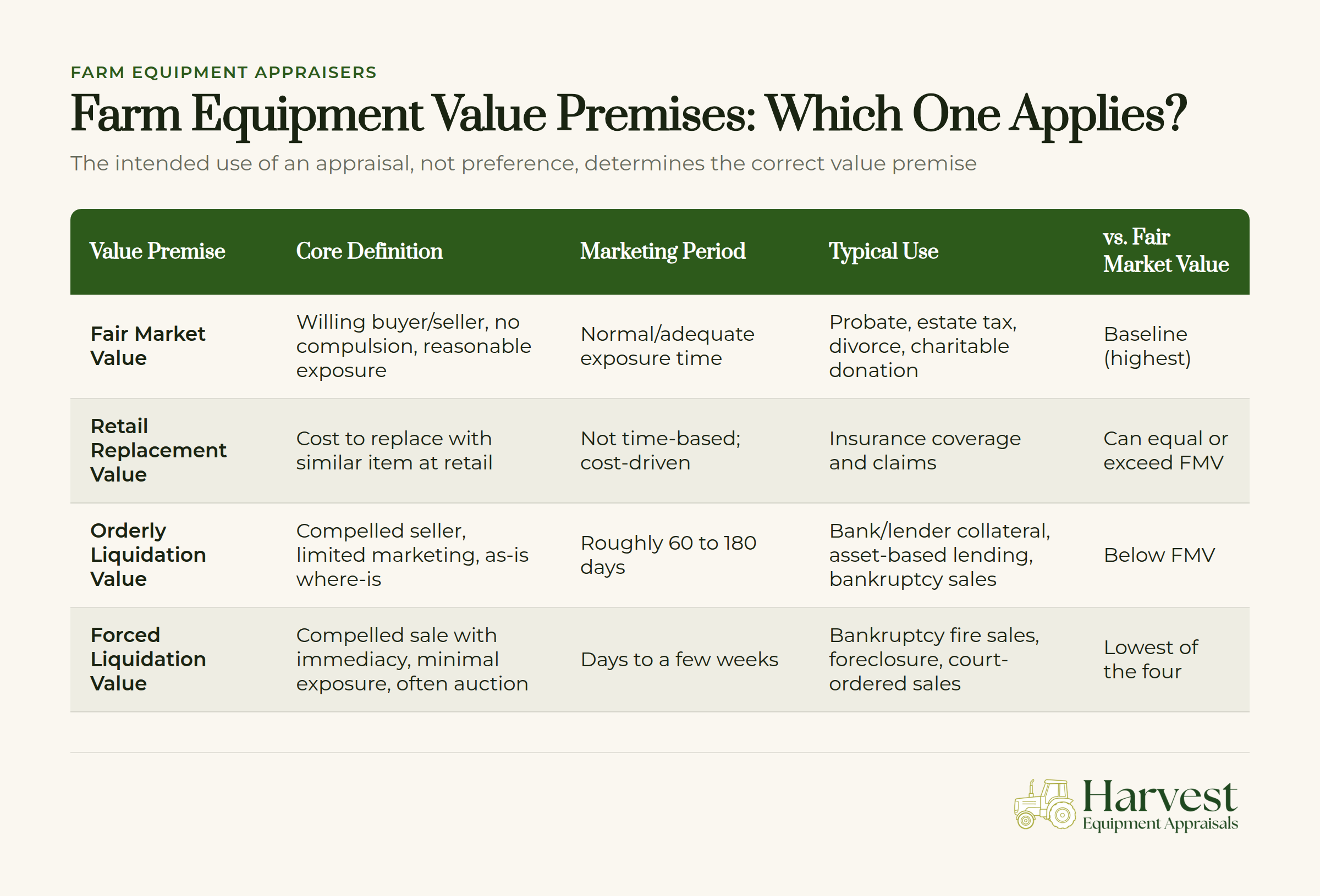
An appraiser does not choose a value premise based on preference. The intended use of the appraisal dictates it, and that is precisely why two credible appraisals of the identical tractor, prepared for two different purposes, can reach two different, equally correct numbers.
| Value Premise | Core Definition | Typical Marketing Period | Typical Intended Use | Relationship to Fair Market Value |
|---|---|---|---|---|
| Fair Market Value | Willing buyer, willing seller, no compulsion, reasonable market exposure | Normal/adequate exposure time | Probate, estate tax, divorce, charitable donation | Baseline (highest of the compulsion-based premises) |
| Retail Replacement Value | Cost to replace with a similar item at retail | Not time-based; cost-driven | Insurance coverage and claims | Can equal or exceed FMV |
| Orderly Liquidation Value | Seller compelled to sell, reasonable limited marketing period, as-is where-is | Roughly 60 to 180 days | Bank/lender collateral, asset-based lending, negotiated bankruptcy sales | Below FMV |
| Forced Liquidation Value | Seller compelled to sell with immediacy, minimal exposure, typically public auction | Days to a few weeks | Bankruptcy fire sales, foreclosure, court-ordered rapid disposition | Lowest of the four |
Why the Same Tractor Can Appraise Differently for Different Purposes
A combine appraised for an estate at fair market value, for a bank loan at orderly liquidation value, and for a bankruptcy filing at forced liquidation value is not a sign that something went wrong in one of the reports. It is a sign that each appraiser correctly matched the premise of value to the assignment's intended use, exactly as the ASA and ISA frameworks require.
Before requesting an appraisal, it helps to be clear about why you need it. A lender reviewing collateral, a probate court settling an estate, an insurer processing a claim, and a bankruptcy trustee converting assets to cash are all asking fundamentally different questions, even when they are all pointing at the same piece of equipment. Knowing which question applies to your situation is the first step toward getting a report that actually serves its purpose.
This article is provided for general informational purposes only and does not constitute legal, tax, or financial advice. Readers should consult a qualified attorney or CPA regarding their specific circumstances.