
Blog
Qualified Appraisal vs Auction Price: Why Farm Equipment Value Needs More Than a Sale Result
An auction record shows what one tractor sold for on one day; it doesn't establish fair market value for an IRS filing or a courtroom. This guide explains when an auction or dealer comparable is good enough and when farm equipment needs a formal qualified appraisal instead.
A neighbor's combine sold at a county consignment auction last month for $85,000. Does that number settle what your combine is worth for a charitable deduction, a probate inventory, or a divorce settlement? Not by itself. An auction price or dealer listing is a useful piece of evidence, but it is not automatically the fair market value figure that the IRS or a court requires, and understanding the gap between the two can save you a denied deduction or a bad day on the witness stand.
What Counts as a Qualified Appraisal for Farm Equipment?
Under federal tax law, a qualified appraisal is a defined term, not a synonym for "someone looked at it and gave a number." Treasury Regulation 1.170A-17 spells out who qualifies as a qualified appraiser and what a compliant report must contain: a description of the equipment, its physical condition, the valuation date, the method used to reach a conclusion, and the reasoning behind it. A general definition of a qualified appraisal is a formal, signed opinion of value that meets IRS content and timing rules, not just any written estimate.
That requirement kicks in once a claimed farm equipment donation, or a group of similar items donated in the same tax year, exceeds $5,000, per the IRS instructions for Form 8283. Below that line, a written appraisal summary on the form itself is enough. Above it, a full narrative report is required, and it generally must be completed no earlier than 60 days before the contribution date.
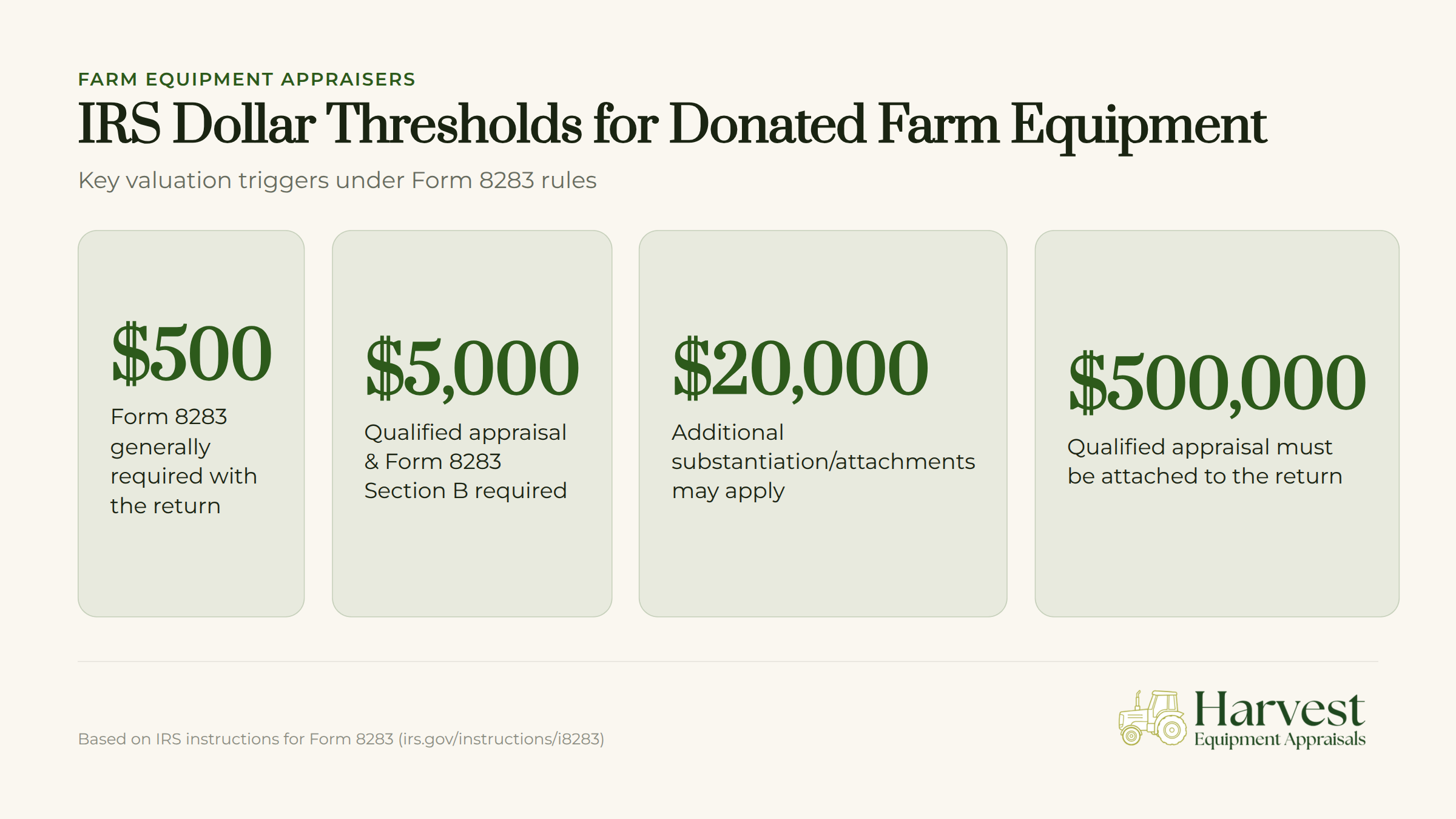
Four dollar thresholds drive most of the paperwork tied to donated farm equipment, based on the Form 8283 instructions:
- More than $500: Form 8283 is generally required with the return for noncash contributions.
- More than $5,000: a qualified appraisal and Form 8283, Section B, are generally required for an item or group of similar items.
- More than $20,000: additional substantiation and attachment requirements may apply, depending on the property.
- More than $500,000: a qualified appraisal generally must be attached to the return itself.
The same underlying principle, that a defensible opinion of value takes more than a transaction record, carries into probate. When farm equipment becomes part of an estate inventory, the executor needs a report that will hold up if the IRS questions the estate's valuation or an heir challenges the distribution. Our farm equipment appraisal for probate engagements follow that same qualified-appraisal discipline, even though the estate tax rules and the charitable-donation rules sit in different parts of the tax code.
Pro tip: If you're donating farm equipment and think you might be close to the $5,000 line, get the appraisal done before you file. A qualified appraisal completed after the fact, or missing the required elements, can cost you the entire deduction even if the underlying value was never in dispute.
What IRS Publication 561 Says About Auction and Dealer Data
The IRS has already weighed in on whether a sale price alone proves fair market value, and the answer is no. IRS Publication 561 is direct about the limits of price guides and comparable sales data.
"Price guides, published statistics, and other measures of comparable sales are not always reliable indicators of fair market value and should be supported by other evidence. The price an item sold for at auction may have been the result of a rigged sale." - IRS Publication 561
That is not a suggestion that auction data is worthless. It is a warning that a single sale result, presented without context, does not carry the weight of an appraisal. An appraiser's job is to test whether a given auction result actually reflects a fair market transaction, or whether it reflects something else entirely, like a forced timeline, a thin pool of bidders, or a seller who needed cash by Friday.
Why an Auction Result Isn't the Same as Fair Market Value
Fair market value assumes a willing buyer and a willing seller, both reasonably informed, neither one under pressure to act. A single auction transaction rarely proves that all three conditions were actually met, which is why one sale record is a data point, not a conclusion.
A few variables explain why two auction results for the same model of tractor can differ by tens of thousands of dollars:
- Reserve vs. absolute auction: A reserve auction lets the seller set a floor price and walk away if bidding falls short. An absolute auction has no floor, which can produce unusually low results when only a handful of buyers show up on sale day.
- Buyer's premium: Many auction houses add 10% to 15% on top of the hammer price. Whether the reported "sale price" includes that premium changes the number an appraiser can actually use.
- Condition at time of sale: Auction listings often describe condition in a sentence or two, without a mechanical inspection. A machine advertised as "runs and drives" could have deferred maintenance that never shows up in the listing.
- Exposure time: Fair market value assumes the property had a reasonable amount of time on the market. A piece consigned into a single-day liquidation sale did not get that exposure, and the result usually runs lower than a normal sale would.
Example: A 2015 combine with 900 separator hours sells at a spring consignment auction for a $145,000 hammer price, plus a 10% buyer's premium the auction house keeps. The sale ran on absolute terms with a hard deadline, so only three bidders competed. An appraiser citing that result as a comparable has to strip out the premium, account for the compressed exposure time, and adjust for any differences in hours, header, or attachments before the number says anything reliable about a different combine.
A dealer's asking price has its own limitation: it is a retail ask, not a completed transaction. Dealers routinely build in negotiating room, and a machine sitting on a lot at a listed price tells you what someone hopes to get, not what a buyer actually paid.
Watch out: Don't build a valuation position around a single TractorHouse listing or one dealer's asking price. It's a starting point for research, not evidence of value on its own.
How Courts Test Valuation Evidence in Divorce and Estate Disputes
When farm equipment value is contested in court, whether in a divorce, a will contest, or a bankruptcy proceeding, the printout that seemed convincing at the kitchen table has to survive rules built to test the reliability of expert evidence. Federal Rule of Evidence 702 requires that expert testimony rest on sufficient facts and data, be the product of reliable principles and methods, and reflect a reliable application of those methods to the facts of the case. Many state and federal courts apply the Daubert framework to scrutinize exactly that: whether the valuation methodology is sound and whether it was applied correctly, not just whether the expert reached a confident-sounding number.
The Uniform Standards of Professional Appraisal Practice, developed by The Appraisal Foundation, is a professional standard rather than a rule of evidence. Courts don't cite USPAP directly the way they cite the Federal Rules. But compliance with USPAP supports defensibility because it forces the same discipline that Rule 702 demands: a clear description of the property, an analysis of comparable data, adjustments for differences, and a reconciled conclusion, rather than a bare number pulled from a listing.
In a divorce, one spouse producing a stack of online listings and the other producing a single auction result rarely resolves anything. Courts want an opinion built on a defined, repeatable methodology, not a printout each side found supportive. Our guide on farm equipment appraisal for divorce walks through how tractors, combines, and sprayers get valued as marital property, and why the report format matters as much as the final figure.
Key takeaway: Auction results and dealer listings are legitimate inputs that a qualified appraiser analyzes, adjusts, and reconciles against other market evidence. They are not a substitute for the appraisal itself, whether the audience is the IRS or a judge.
When an Informal Comparable Is Fine, and When You Need a Qualified Appraisal
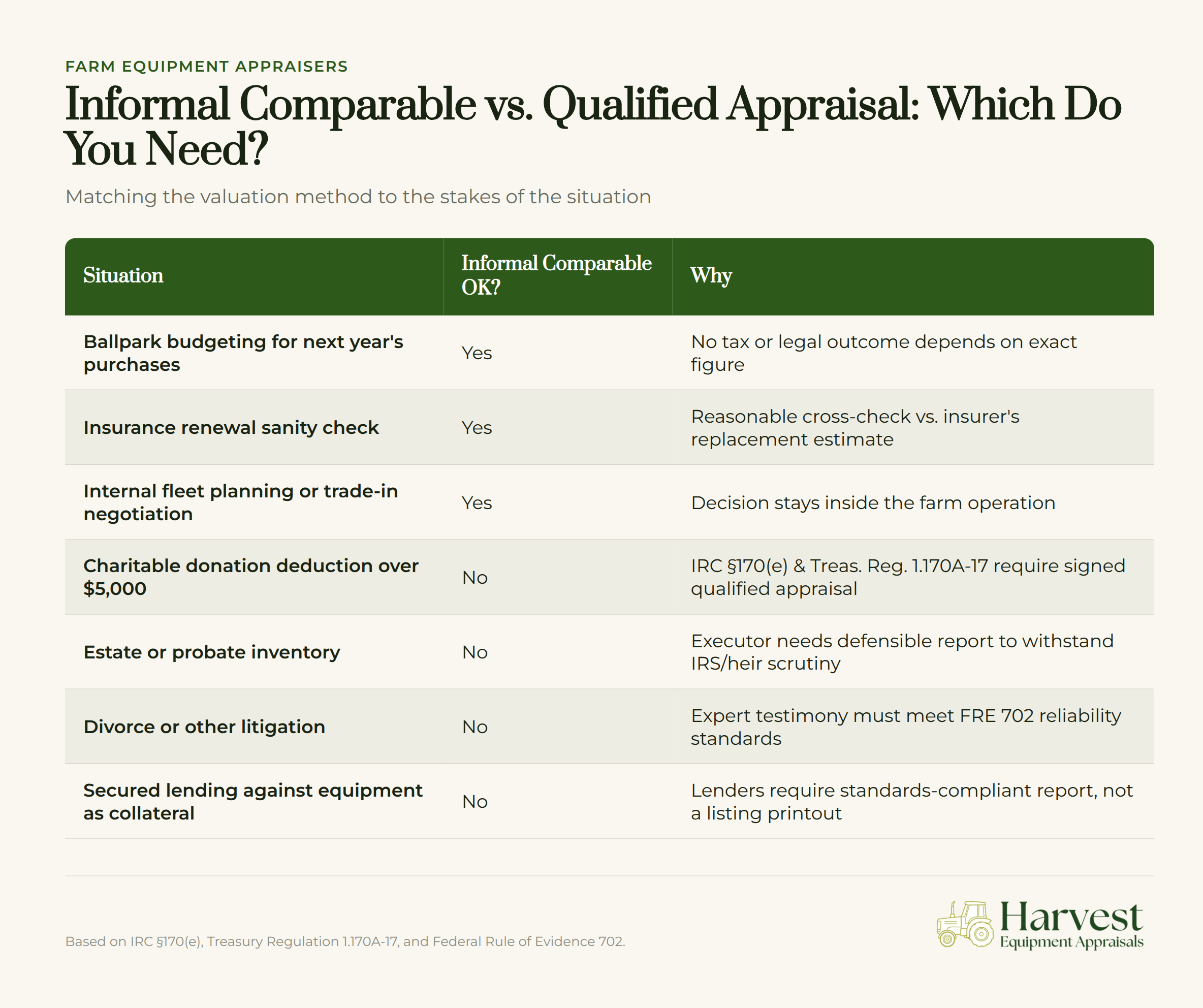
Not every valuation question requires a formal report. The table below sums up when a comparable sale or dealer listing is good enough, and when the situation calls for a full qualified appraisal.
| Situation | Informal Comparable OK? | Why |
|---|---|---|
| Ballpark budgeting for next year's equipment purchases | Yes | No tax or legal outcome depends on the exact figure |
| Insurance renewal sanity check | Yes | A comparable is a reasonable cross-check against the insurer's replacement cost estimate |
| Internal fleet planning or trade-in negotiation | Yes | The decision stays inside the farm operation |
| Charitable donation deduction over $5,000 | No | IRC §170(e) and Treasury Regulation 1.170A-17 require a signed, qualified appraisal |
| Estate or probate inventory | No | The executor needs a defensible report that can withstand IRS or heir scrutiny |
| Divorce or other litigation | No | Expert testimony must meet Federal Rule of Evidence 702 reliability standards |
| Secured lending against equipment as collateral | No | Lenders generally require a standards-compliant report, not a listing printout |
What a Qualified Farm Equipment Appraisal Costs
Farm equipment appraisal fees are quoted as a fixed fee after we scope the assignment, never billed hourly. A standard report starts at $295, and an IRS-qualified report suitable for a charitable donation, estate matter, or litigation starts at $395. Typical engagements run $695 to $2,200 depending on the number of machines involved, the completeness of maintenance and title records, and the depth of analysis the intended use requires; a full fleet appraisal for a large operation facing estate settlement or a legal dispute can run $5,000 to $10,000 or more.
The fee reflects the scope of the assignment, not the value of the equipment. A tractor worth $30,000 and one worth $300,000 cost the same to appraise if the record-keeping and analysis required are comparable; what changes the price is the number of machines, the quality of the documentation you can provide, and whether the report needs to meet IRS-qualified or litigation-grade standards.
The Bottom Line on Auction Data and Appraisals
An auction record or dealer listing tells you what happened in one transaction, under one set of conditions, on one day. That is useful information for an appraiser to analyze, but it is not the finished product the IRS or a court is asking for. Once real money, a tax filing, or a legal dispute is on the line, the report needs to explain the property, the market, the method, and the reasoning, not just cite a number someone else's machine sold for.
If you're weighing whether your situation calls for a qualified appraisal, our team can scope the assignment and quote a fixed fee before any work begins. Request an appraisal to get started.
This article is provided for general informational purposes only and does not constitute legal, tax, or financial advice. Readers should consult a qualified attorney or CPA regarding their specific circumstances.