
Blog
Replacement Cost vs Fair Market Value: Which One Actually Insures Your Farm Equipment?
Replacement cost and fair market value are not interchangeable terms on a farm equipment policy, and mixing them up can leave a claim check far short of what it takes to replace a tractor or combine. This guide explains how each standard schedules equipment, how the coinsurance penalty punishes an underinsured schedule, and when an independent appraisal should set or defend your values.
Replacement cost value and fair market value are the two standards insurers use to schedule tractors, combines, and implements on a farm policy, and the gap between them can decide whether a claim check actually covers your loss. Many farm personal property forms default to actual cash value unless a replacement-cost endorsement is added, and a stale or guessed-at equipment schedule can trigger a coinsurance penalty on top of that gap. This guide breaks down how each valuation standard works, walks through the coinsurance math with real numbers, and covers when our farm equipment appraisal services should set or defend the values on your schedule.
What Replacement Cost Value Means for Scheduling Farm Equipment
Replacement cost value is the amount it would take, at the time of loss, to buy equipment of similar kind and quality, without subtracting anything for wear or age. Cornell's legal reference material describes replacement value as the present amount needed to replace an item with one of similar kind and quality, distinguishing it from actual cash value by the absence of a depreciation deduction.
For a farm operation, that distinction matters because used-equipment age and hours do not reduce the payout under a true replacement-cost settlement. A 12-year-old combine insured on a replacement-cost basis is valued at what a comparable new or reasonably equivalent machine costs today, not at what the old combine could fetch on the used market. That can be a large number, especially after a few years of rising new-equipment prices.
Replacement cost coverage usually comes with strings attached. Policies can require the insured to actually replace the damaged equipment, do so within a set period, replace it with equipment of like kind and quality, and submit invoices or other proof of cost before the full replacement-cost amount is paid. Some policies pay actual cash value first and release the depreciation holdback only after a qualifying replacement is completed.
What Fair Market Value and Actual Cash Value Mean for Scheduling
Fair market value is the price a willing buyer would pay a willing seller, with neither party under compulsion to transact, as described in University of Missouri Extension's guidance on market value. For farm equipment, that number usually tracks the used-equipment market rather than the cost of a new machine, and it can be substantially lower.
Actual cash value is often calculated as replacement cost minus physical depreciation, though the exact formula depends on the policy and the state. A multi-state survey of insurance law identifies three recurring methods courts and regulators use when a policy does not spell out its own definition of actual cash value: fair market value, replacement cost less depreciation, and the broad evidence rule, which weighs all relevant evidence of value together, according to a 50-state legal survey. That means actual cash value and fair market value are related concepts, but they are not always calculated the same way, and the applicable method can shift from state to state.
Condition-dependent estimates add another layer of uncertainty. Machinery-cost research from Iowa State University Extension treats salvage or trade-in value as only an estimate, cautioning that actual value depends heavily on a machine's condition, the new-equipment market at the time, and local buyer preferences. That caution applies directly to insurance valuation: a generic depreciation schedule can miss what a specific tractor or planter is really worth.
Why Many Farm Policies Default to Actual Cash Value
Unless a farm policy specifically adds a replacement-cost endorsement for scheduled equipment, many farm personal property forms settle losses at actual cash value by default. That default shifts the depreciation risk onto the farm operation: older machines recover less, even though replacing them still costs full new-equipment price. General farm insurance guidance on scheduling equipment confirms that the valuation basis, replacement cost, actual cash value, or a stated or agreed amount, has to be selected and endorsed on the policy rather than assumed, as outlined in industry guidance on farm equipment insurance.
The label an agent uses in conversation is not the same as the contract language. The declarations page, the equipment schedule, the valuation clause, any endorsements, the deductible, and the loss-settlement provisions together determine whether a given tractor or combine is actually insured on a replacement-cost basis, an actual cash value basis, or a stated or agreed value.
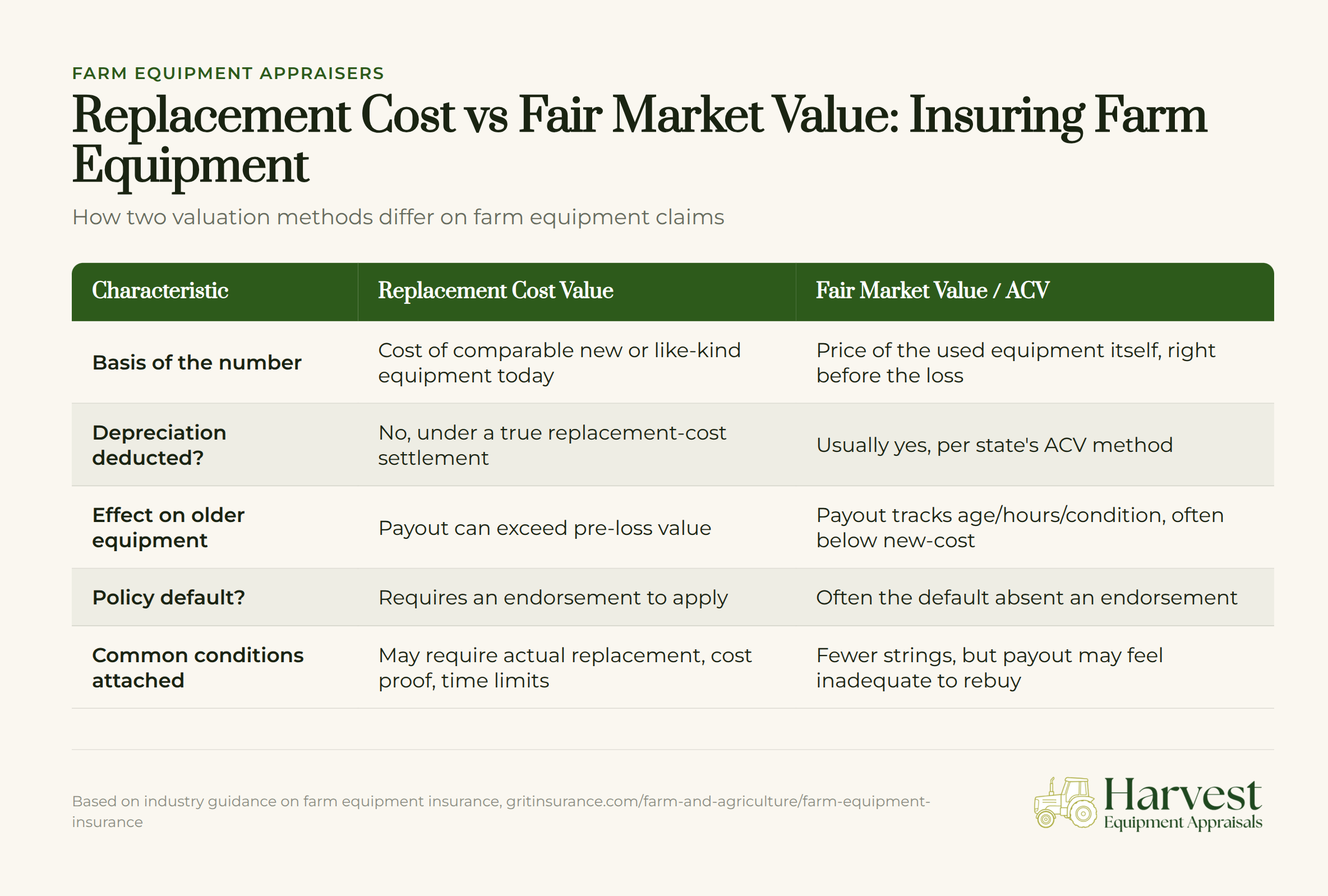
| Characteristic | Replacement Cost Value | Fair Market Value / Actual Cash Value |
|---|---|---|
| Basis of the number | Cost of comparable new or like-kind equipment today | Price of the equipment itself, used, immediately before the loss |
| Depreciation deducted | No, under a true replacement-cost settlement | Usually yes, or determined by a state's actual cash value method |
| Typical effect on older equipment | Payout can exceed the machine's pre-loss value | Payout tracks age, hours, and condition, often well below new-equipment cost |
| Default on many farm forms | Requires an endorsement to apply | Often the policy default absent an endorsement |
| Common conditions attached | May require actual replacement, proof of cost, time limits | Fewer strings, but payout may feel inadequate to rebuy |
How the Coinsurance Clause Penalizes an Underinsured Schedule
A coinsurance clause requires the insured to carry coverage equal to a set percentage, commonly 80%, of the equipment's full replacement value. If the amount of insurance carried falls below that requirement, the insurer pays only a proportional share of any loss, even a loss far smaller than the policy limit.
The formula insurers use is straightforward: divide the amount of insurance actually carried by the amount of insurance required, then multiply that ratio by the loss. The result is the payment before the deductible is applied.
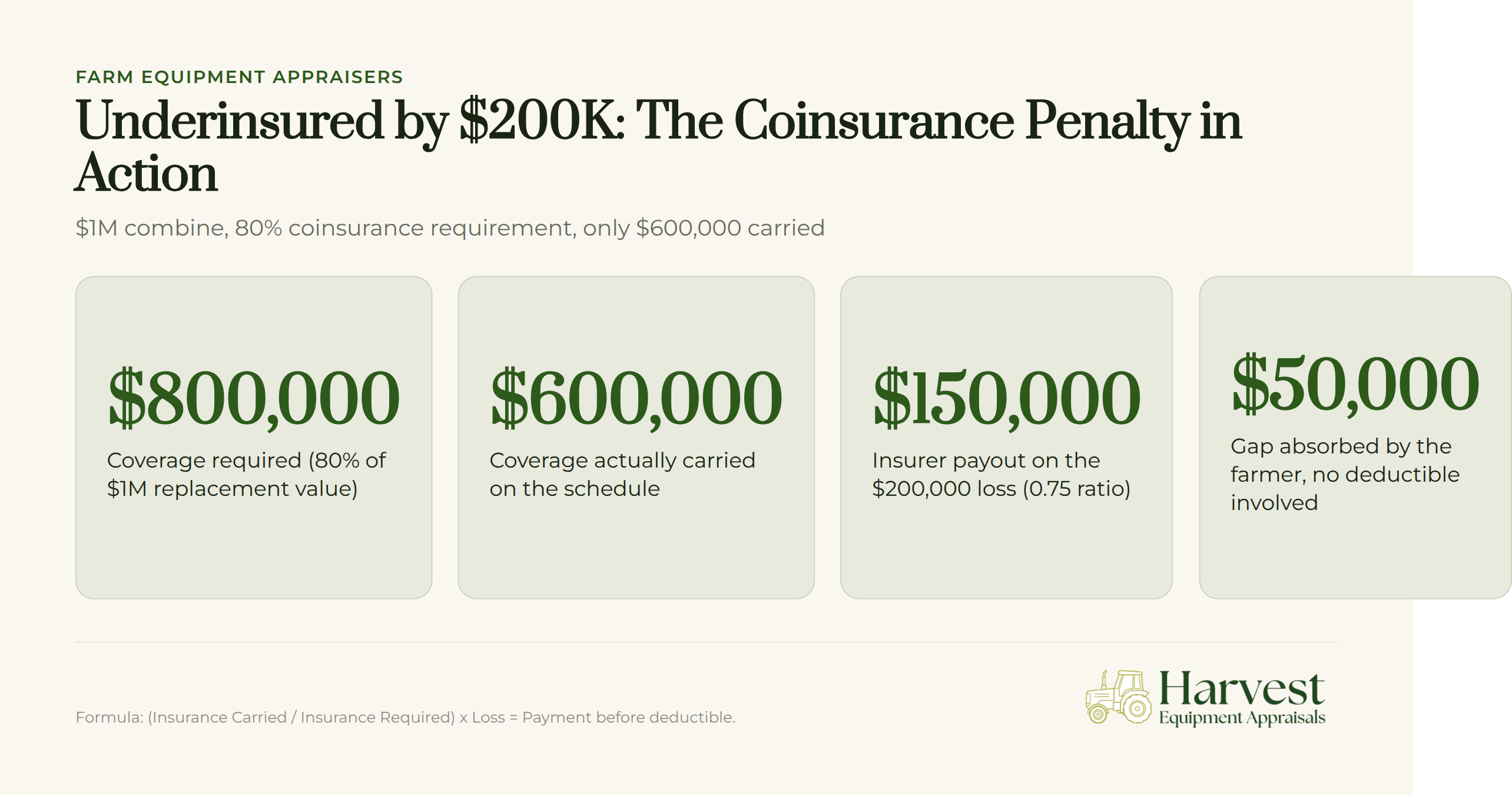
Example: A farm schedules a combine with a replacement value of $1,000,000 under a policy carrying an 80% coinsurance requirement. That means the farmer needed to carry at least $800,000 in coverage ($1,000,000 x 80%). Instead, the policy only carries $600,000. A partial loss occurs causing $200,000 in damage.
- Coverage required: $1,000,000 x 80% = $800,000
- Coverage carried: $600,000
- Coinsurance ratio: $600,000 / $800,000 = 0.75
- Payment: 0.75 x $200,000 = $150,000
The farmer absorbs the remaining $50,000 of the $200,000 loss, not because of a deductible, but purely because the schedule was underinsured relative to the required 80%. The same $200,000 loss on a fully insured schedule carrying the full $800,000 (or more) would have paid in full.
Watch out: A coinsurance penalty applies even on a partial loss. Farmers often assume coinsurance only matters for a total loss, but the math above shows the penalty hits proportionally on any claim once the carried amount falls below the required percentage of replacement value. An outdated schedule written five years ago, before used and new equipment prices climbed, is a common way farms end up underinsured without realizing it.
When to Get an Independent Fair Market Value Appraisal
An independent appraisal is worth commissioning any time the number on your equipment schedule is a guess rather than a documented value. A few situations come up repeatedly:
- Before a policy renewal: Insurers and farmers both benefit from a current, defensible number instead of carrying forward a figure from years earlier.
- After buying or upgrading equipment: A new planter, combine head, or precision-ag retrofit changes the replacement cost and the coinsurance math behind it.
- When used equipment prices spike: Years of strong demand can push used tractor and combine values well above what an old depreciation schedule assumes, which can widen the gap between carried coverage and required coverage.
- When a claim is disputed: If an insurer's adjuster and a farm operation disagree on what a damaged machine was worth before the loss, a credentialed appraisal gives both sides a documented, defensible number instead of a negotiation based on guesswork.
Our tractor appraisal work and broader farm equipment appraisal engagements are built to document fair market value with the kind of records an adjuster, underwriter, or attorney can actually rely on: comparable sales, condition notes, hours, and model-specific detail rather than a generic depreciation table. Fees for a farm equipment appraisal are quoted as a fixed fee after we scope the assignment, with standard reports starting at $295 depending on the number of machines and the depth of documentation needed; engagements are never billed hourly.
Protect the Number Before You Need It
The practical lesson is simple: the words "replacement cost" or "fair market value" printed in a policy are only the starting point. What actually pays out depends on the valuation clause, any endorsements, the coinsurance percentage, and whether the scheduled amount still reflects what the equipment is really worth today. Getting an independent appraisal before renewal, after a major purchase, or during a disputed claim is the most direct way to close the gap between what a policy promises and what it actually pays.
This article is provided for general informational purposes only and does not constitute legal, tax, or financial advice. Readers should consult a qualified attorney, CPA, or insurance professional regarding their specific circumstances.