
Blog
Stepped-Up Basis for Inherited Farm Equipment: How Appraised Value Affects Heirs' Taxes
When a farmer inherits equipment, the date-of-death appraised value, not the original purchase price, becomes the heir's tax basis under stepped up basis farm equipment rules. This guide walks through how that number resets depreciation and shapes the capital gains bill on a future sale.
When farm equipment passes from a deceased owner to an heir, the tax code effectively hits a reset button on the machine's paper trail. The decedent's original purchase price, every dollar of depreciation claimed over the years, and any built-in gain all disappear for tax purposes. What replaces them is a single number: the equipment's fair market value on the date of death. That number becomes the heir's new tax basis, and it can swing the heir's future tax bill by tens of thousands of dollars depending on how carefully it was documented.
This is where a qualified probate and estate appraisal earns its keep. The appraisal isn't paperwork for its own sake. It's the document that sets the number the IRS, the estate's accountant, and eventually the heir will all rely on for years to come.
What Is Stepped-Up Basis, and Why Does It Matter for Farm Equipment?
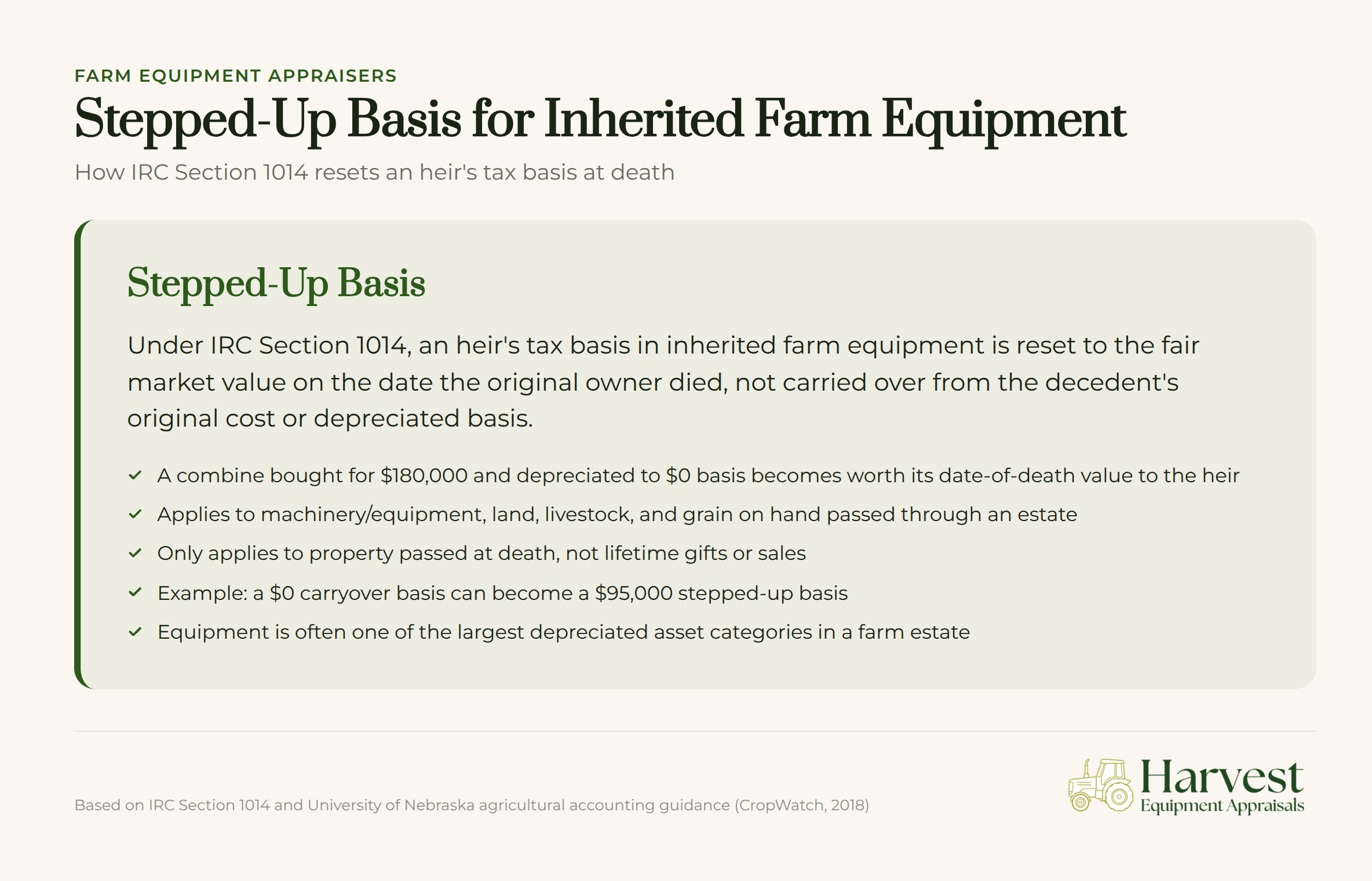
Stepped-up basis is the rule under Internal Revenue Code Section 1014 that resets an heir's tax basis in inherited property to its fair market value on the date the original owner died, rather than carrying over the decedent's original cost. For farm equipment, that means a combine the decedent bought for $180,000 and depreciated down to $0 doesn't hand the heir a $0 basis. It hands the heir a fresh basis equal to whatever the machine was actually worth on the day the owner died.
Agricultural tax guidance specifically calls out machinery and equipment, alongside land, livestock, and grain on hand, as property that receives this treatment when it passes through an estate rather than through a lifetime gift or sale, per University of Nebraska agricultural accounting guidance. This is a meaningful distinction for farm families, because equipment is often one of the largest depreciated asset categories in the estate, and the difference between a $0 carryover basis and a $95,000 stepped-up basis changes everything about how the heir is taxed going forward.
The General Rule: Fair Market Value on the Date of Death
The default rule is straightforward: the heir's basis equals the equipment's fair market value on the date the decedent died. Fair market value here means the price a willing buyer and willing seller would agree on, with neither one under pressure to act and both reasonably informed about the equipment's condition, hours, and market. That is the same fair market value standard used throughout federal estate tax valuation.
This is also why the appraisal needs to reflect a specific date rather than a general market opinion. An appraiser working a date-of-death assignment has to research comparable sales, dealer listings, and auction results as they existed around that specific date, not the date the report happens to get written. The Internal Revenue Service Publication 551 covers how basis is determined for inherited and other property, and it treats the date-of-death value as the starting point for everything that follows, including how the equipment gets depreciated if the heir keeps farming with it. That depreciation question matters enough that it deserves its own section, and heirs often ask whether equipment depreciates over 5 or 7 years once they understand the basis has reset.
The Alternate Valuation Date Election Under Section 2032
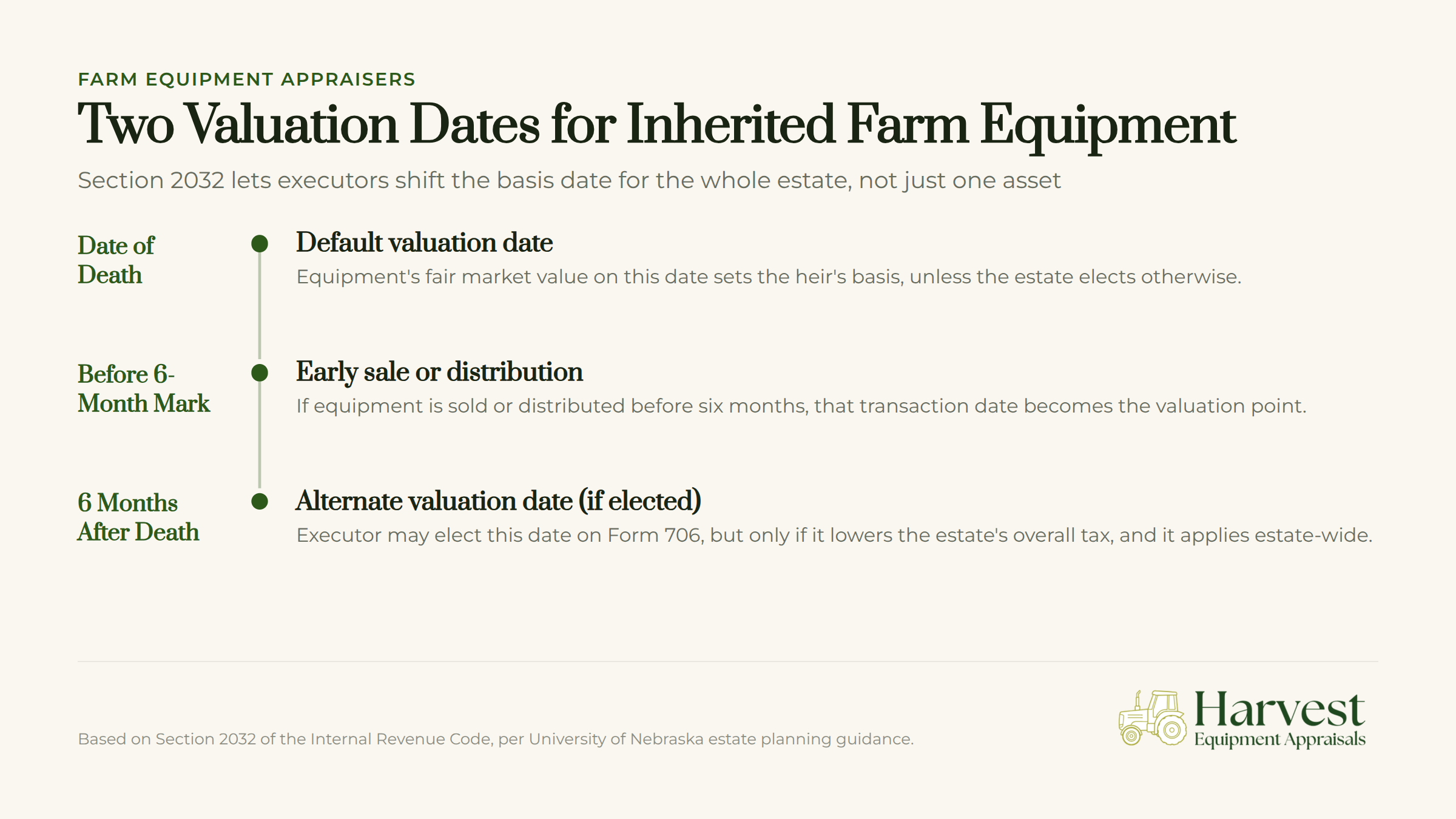
Estates don't always have to use the date-of-death value. Section 2032 of the Internal Revenue Code lets the executor elect an alternate valuation date, six months after death, for federal estate tax purposes, according to University of Nebraska estate planning guidance. If the estate makes this election on Form 706, the equipment's basis for the heir shifts to its fair market value on that six-month date instead of the date of death.
A few mechanics matter here for equipment specifically:
- The election is estate-wide, not asset-by-asset. An executor cannot elect the alternate date for the tractor and the date-of-death value for the combine. The choice applies to every asset in the estate.
- The election is only available if it lowers the overall estate tax. It exists to give relief to estates whose total value dropped between the date of death and six months later, not as a general planning tool.
- Assets sold or distributed before the six-month mark are valued as of the date they were disposed of. If the heir sells or receives the equipment before the six-month date arrives, that transaction date becomes the relevant valuation point.
Because this election affects the whole estate, the farm equipment appraisal usually needs to be part of a broader conversation with the estate's attorney or CPA. Our farm equipment appraisal for probate and estate settlement work often runs alongside that broader estate valuation, precisely because the equipment number has to line up with whichever valuation date the estate ultimately elects.
How the Step-Up Resets Depreciation for Heirs Who Keep Farming
If the heir keeps the equipment in the farm operation instead of selling it, the stepped-up value becomes the starting point for a brand-new depreciation schedule. The heir does not inherit the decedent's remaining depreciable basis, which by the time of death is often $0 or close to it after years of MACRS deductions and Section 179 or bonus depreciation elections.
Instead, the heir begins depreciating the equipment from its full stepped-up value, following the recovery periods and conventions set out in IRS Publication 946. A combine with a $95,000 stepped-up basis gets treated, for depreciation purposes, as though the heir bought a $95,000 combine on the date they inherited it. This is one of the more overlooked benefits of the step-up rule: it doesn't just erase the decedent's built-in gain, it also hands the heir a full new round of depreciation deductions on equipment that may have already been fully written off once.
Capital Gains and Section 1245 Recapture When the Heir Sells
The step-up rule has an equally important effect if the heir decides to sell the equipment rather than keep using it. Because the decedent's original depreciation is wiped out along with the old basis, the heir's capital gain calculation starts fresh. Only the depreciation the heir personally claims after inheriting the equipment is subject to depreciation recapture under Section 1245 on a later sale. A financial case involving depreciation recapture on inherited property illustrates the same principle: the original owner's decades of depreciation created no recapture liability for the heirs because the step-up erased the built-in gain entirely, as described in this account of an inherited depreciation recapture case.
Key takeaway: The IRS cannot claw back depreciation the decedent claimed during their lifetime. Recapture on a later sale is calculated only against depreciation the heir claims after the date of death.
Worked Example
Example: A farmer bought a combine in 2010 for $180,000 and fully depreciated it to a $0 adjusted basis by the time of death in 2023. A qualified appraisal sets the date-of-death fair market value at $95,000, which becomes the heir's new basis.
- If the heir sells the combine immediately for $95,000, there is no taxable gain, because the sale price equals the new basis exactly.
- If the heir keeps farming with the combine and claims $27,000 of depreciation over the next two years under a fresh MACRS schedule, the adjusted basis drops to $68,000.
- If the heir then sells the combine for $80,000, the taxable gain is $12,000 ($80,000 minus $68,000 adjusted basis), and all $12,000 is Section 1245 recapture tied to the depreciation the heir claimed, not to any of the decedent's prior deductions.
Why the Appraisal Needs to Happen Close to the Date of Death
An appraisal performed months or years after death, sometimes called a retrospective appraisal, is harder to defend than one completed close to the valuation date. Market data ages quickly for farm machinery: dealer inventory, auction comparables, and regional demand shift from season to season, and reconstructing what a specific combine or tractor was actually worth on a date years in the past leaves more room for challenge from a CPA, the IRS, or a co-heir disputing the number.
Watch out: Waiting to get equipment appraised until a return is being prepared, or until the heir decides to sell, often means working with thinner records and less reliable comparable sales data than an appraisal completed within weeks of the date of death.
A farm equipment appraisal completed shortly after death, prepared in accordance with USPAP, gives the estate a defensible, dated record of fair market value. That record is what protects the heir's basis if it is ever questioned on audit, in a dispute among heirs, or by an accountant preparing the estate's final return. For an engagement like this, our fee for a farm equipment appraisal is quoted as a fixed fee after we scope the assignment, based on the number of machines, the complexity of the fleet, and whether the report needs to meet IRS-qualified standards; it is never billed by the hour.
Getting the Basis Right From the Start
Heirs rarely think about depreciation schedules and recapture in the weeks after losing a family member, but the appraisal completed during that window is the one number that follows the equipment for as long as the heir owns it. Getting a qualified, dated appraisal in place early protects the heir's basis, supports the estate's Form 706 if one is required, and gives everyone a defensible answer if the number is ever questioned later.
Our team prepares farm equipment appraisals for estates and probate matters with that timeline in mind, working directly with executors, attorneys, and CPAs to make sure the valuation date and the appraisal date match up.
This article is provided for general informational purposes only and does not constitute legal, tax, or financial advice. Readers should consult a qualified attorney or CPA regarding their specific circumstances.