
Blog
Cheap Farm Equipment Appraisal: When Dealer Quotes and Online Estimates Fail Court, Lender, and IRS Review
A cheap farm equipment appraisal, whether a dealer quote or a low-cost online estimate, is useful market evidence but is usually not a qualified appraisal. This guide compares 4 value sources against the 5 recipients that review them and shows when an informal number falls short.
Published
Key Takeaways on Cheap Farm Equipment Appraisals
Here is what owners, heirs, and donors need to know about relying on a dealer quote or low-cost online estimate:
- Dealer quotes and online estimates: A dealer quote or online estimate works as market evidence and preliminary screening. Neither one usually meets the standard of a qualified appraisal.
- IRS threshold: The IRS generally requires a qualified appraisal when donated farm equipment is claimed at more than $5,000. Form 8283 Section B must be signed by the appraiser.
- Intended use: The purpose of the valuation, not the price of the document, decides whether a number holds up. Courts, lenders, insurers, and trustees each decide what they accept.
- Delivery and fees: Farm equipment appraisals are delivered online by default and quoted as a fixed fee before work begins. Fees follow scope, not the value of the machine.
A cheap farm equipment appraisal is tempting when a single tractor, combine, or sprayer needs a number. A $100 online estimate or a free dealer quote answers the question "what is this roughly worth?" Reviewers such as the IRS, a probate court, a lender, or a bankruptcy trustee ask a different question: what value was concluded, for what purpose, by whom, and with what support. This guide compares the common value sources and shows where informal numbers stop being enough.
How Does a Cheap Farm Equipment Appraisal Differ From a Formal Appraisal?
A cheap farm equipment appraisal differs from a formal appraisal in purpose, method, and authorship: an informal figure estimates a price, while a formal appraisal supports a stated value conclusion for a stated use. The difference shows up in what each document contains.
A dealer quote reflects what one dealer would pay or charge. That view is a trade-in or retail perspective, and it often skips serial numbers, engine hours, attachments, and condition notes.
An auctioneer opinion reflects what a machine might bring at a sale. That view sits closer to liquidation, and it rarely states a valuation date or definition of value.
An online valuation tool generalizes from make, model, and year. The tool cannot see the machine's maintenance history, modifications, or liens.
A formal USPAP-compliant appraisal identifies the client, intended use, effective date, definition of value, inspection method, data sources, and methodology, then supports the conclusion. Appraisal industry guidance for users of reports lists these same elements as the content a personal property report must carry.
Farm Equipment Value Sources Compared by Recipient
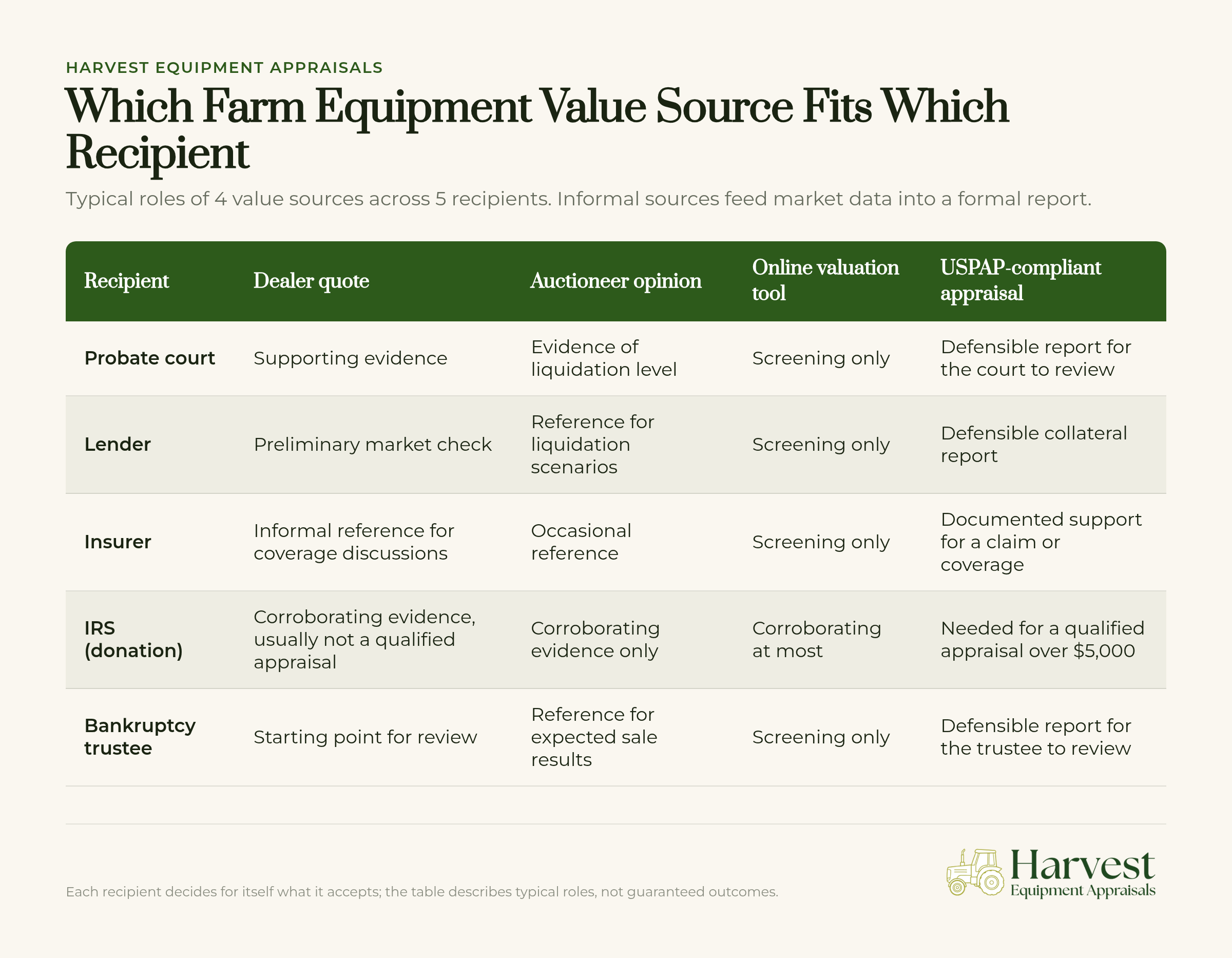
The table below shows how 4 value sources typically fit with 5 common recipients. Each recipient decides for itself what it accepts, so the table describes typical roles, not guaranteed outcomes.
| Value source | Probate court | Lender | Insurer | IRS (donation) | Bankruptcy trustee |
|---|---|---|---|---|---|
| Dealer quote | Supporting evidence | Preliminary market check | Informal reference for coverage discussions | Corroborating evidence, usually not a qualified appraisal | Starting point for review |
| Auctioneer opinion | Evidence of liquidation level | Reference for liquidation scenarios | Occasional reference | Corroborating evidence only | Reference for expected sale results |
| Online valuation tool | Screening only | Screening only | Screening only | Corroborating at most | Screening only |
| USPAP-compliant appraisal | Defensible report for the court to review | Defensible collateral report | Documented support for a claim or coverage | Needed for a qualified appraisal over $5,000 | Defensible report for the trustee to review |
The pattern is consistent. Informal sources feed into a formal report as market data, and the formal report gives the reviewer a signed, dated document with a stated intended use and effective date to examine.
IRS Standards for Donated Farm Equipment
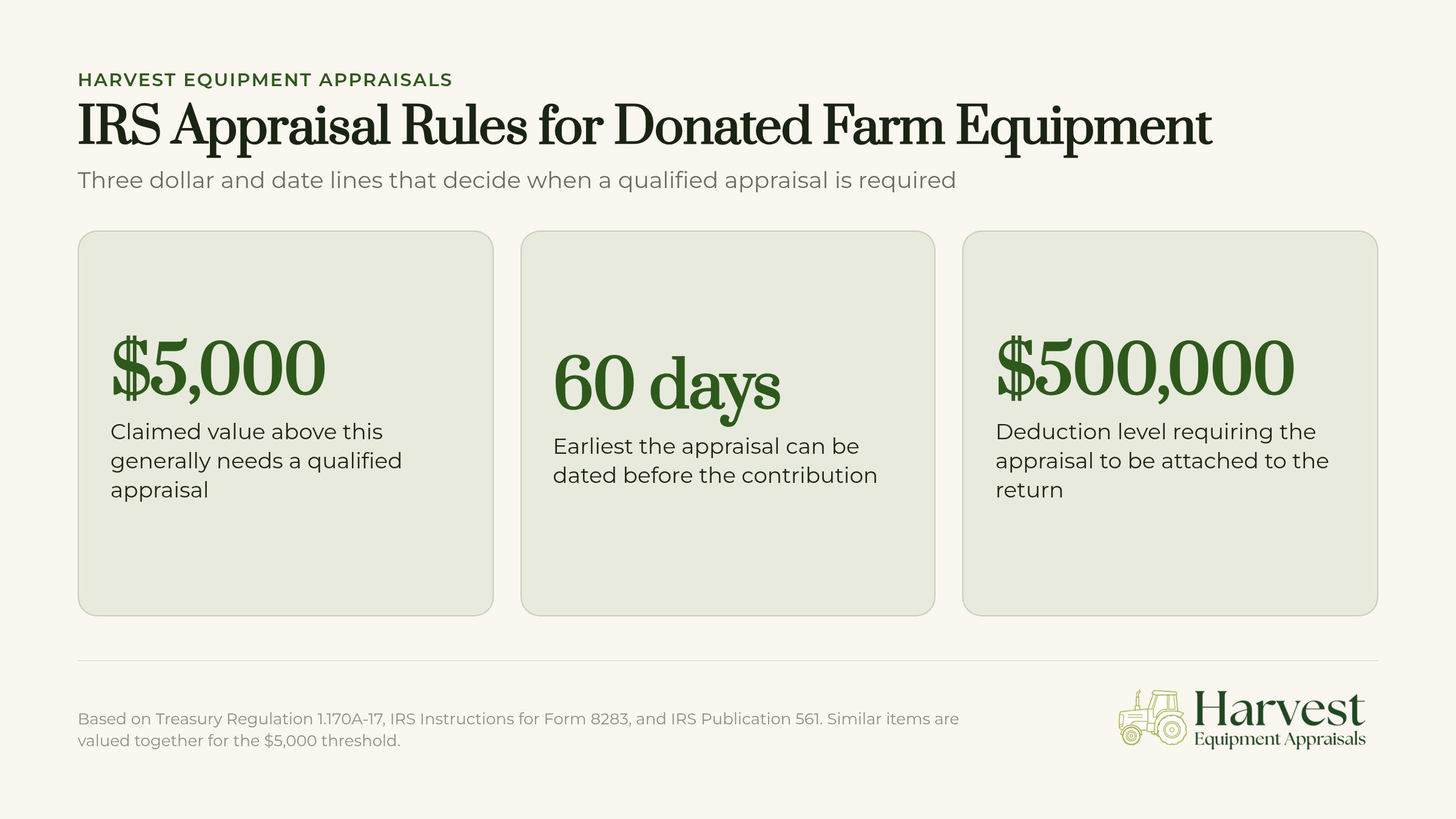
IRS rules set the clearest dollar line: donated farm equipment claimed at more than $5,000 generally needs a qualified appraisal. Treasury Regulation 1.170A-17 governs the requirement, and the IRS Instructions for Form 8283 explain how the appraisal is reported on Section B of the form.
A qualified appraisal carries specific features:
- Qualified appraiser: The appraiser must be qualified to value the type of property and must sign a declaration about education, experience, and professional affiliations.
- Generally accepted standards: The report must follow generally accepted appraisal standards, including the principles of USPAP.
- Required content: The report must describe the property, its condition, the valuation date, the fair market value, and the method used.
- Timing: The appraisal is dated no earlier than 60 days before the contribution and no later than the return due date, including extensions.
- Signature: The appraiser signs Form 8283 Section B.
Fair market value under IRS Publication 561 is the price between a willing buyer and a willing seller on the open market. That price reflects the used-equipment market and the machine's actual condition, not the new replacement price.
A dealer quote or online estimate usually is not a qualified appraisal. Either can still serve as corroborating evidence inside one. A claimed deduction of $500,000 or more also requires the qualified appraisal to be attached to the return. The Form 8283 filing guide for farm equipment donations walks through the form line by line.
Example: A farmer donates 3 similar implements, and dealer quotes put them at $2,200, $1,900, and $1,700. Each item sits under $5,000, yet the group totals $5,800. Similar items are valued together for the threshold, so the donation needs a qualified appraisal.
Court, Lender, and Trustee Review of Informal Farm Equipment Values
Probate courts, lenders, insurers, and bankruptcy trustees each set their own standard for valuation evidence. The reviewing party decides what it accepts, and a reviewer can question a number that arrives without support.
A dealer quote or online estimate often leaves these questions unanswered:
- Intended use and date: The document does not state why the value was prepared or the date it applies to.
- Type of value: The figure does not say whether it represents retail, trade-in, continued use, orderly liquidation, or forced liquidation.
- Identification: The document does not verify the machine's serial number, hours, or attachments.
- Condition: The preparer did not inspect the equipment or record its condition.
- Method: The comparable sales and adjustments behind the number are not explained.
- Authorship: The document carries no signed statement of the preparer's qualifications or limiting conditions.
The type of value matters because a tractor in an operating farm has a different value than the same tractor at an immediate auction. In litigation, an expert's valuation is judged on the sufficiency of facts and the reliability of method, so a short unsigned estimate offered as expert evidence is more exposed than one used as preliminary information. A signed, dated, USPAP-compliant report with a stated intended use and effective date gives the reviewer something defensible to examine.
USPAP Scope of Work and the Cheap Farm Equipment Appraisal
USPAP, published by The Appraisal Foundation, limits how far an appraiser can narrow an assignment to reduce cost. The USPAP standards require the scope of work to be sufficient to produce credible results for the intended use. An appraiser cannot trim research, inspection, or analysis so far that the conclusion stops being credible for its purpose.
Personal property work, including farm machinery, falls under USPAP Standards 7 and 8. Standard 7 covers developing the appraisal, and Standard 8 covers reporting the results. The framework requires the appraiser to identify the intended use and users, the effective date, the property characteristics, the definition of value, and the scope of work.
A low-priced product can be a legitimate choice when the intended use is informal. The product stops being legitimate when the intended use needs a credible, defensible conclusion and the scope was cut below that level.
When a Cheap Farm Equipment Appraisal Creates Risk
A cheap farm equipment appraisal creates the most risk when the number will be reviewed by someone with authority to challenge it. The risk concentrates in 4 situations:
- Small estates: An executor who values a few machines from a dealer quote can face questions from heirs or the court about how the figure was reached, even when the dollar amounts are modest.
- Low-value machines in aggregate: Several older implements that each look minor can add up to a donation over $5,000 in similar items, and the aggregate triggers the qualified appraisal requirement.
- Collateral disputes: A borrower and lender who disagree on equipment value need a report that defines the type of value and shows its support. A single quote gives neither side a shared basis.
- Bankruptcy and divorce matters: A trustee or opposing party reviews valuation evidence critically. An unsupported number invites challenge and delay.
Fixing the problem later costs more than preparing the right document first. A donor who files with an informal quote and is later questioned must obtain a compliant appraisal against the timing rules, and the dating window can already have closed.
What a Formal Farm Equipment Appraisal Costs
Harvest Equipment Appraisals publishes its fees for farm equipment. A standard appraisal starts at $295, and an advanced appraisal prepared for IRS qualified-appraisal use starts at $395. Typical engagements run $695 to $2,200, and the most complex engagements run $5,000 to $10,000 or more. The full schedule is on the pricing page.
Fees follow scope. Four factors drive the fee:
- Complexity: Specialized or heavily modified machines need deeper research than standard models.
- Records quality: Complete maintenance logs, titles, and serial numbers shorten the research.
- Number of units: A fleet of 30 machines needs more work than a single tractor.
- Intended use: An IRS-qualified report carries more reporting requirements than a standard one.
Every engagement is quoted as a fixed fee before work begins and is never billed hourly. The machine's market value does not change the fee. Value affects the concluded number, not the cost of producing it.
Online delivery is the default for farm equipment. Owners send photographs, serial numbers, hours, and records, and Harvest Equipment Appraisals completes the appraisal remotely. On-site inspection is reserved for much larger projects. Our appraisers hold credentials with leading organizations such as the ASA and CAGA, and each report is prepared in accordance with USPAP.
Choosing Between an Informal Value and a Formal Farm Equipment Appraisal
An informal value fits informal decisions: whether to sell, roughly what to ask, or whether a full appraisal is worth the cost. A formal appraisal fits any decision that another party will review, including a donation over $5,000, a probate inventory, a collateral dispute, an insurance claim, or a bankruptcy filing.
The practical test is simple. Identify who will read the number, then ask what that reader needs to see: the intended use, the effective date, the type of value, the method, and the appraiser's qualifications. A document missing those items is market evidence. A signed, dated, USPAP-compliant report with those items gives the reviewer a defensible record to evaluate.
Owners who already hold a dealer quote do not need to discard it. Our appraisers can use it as one data point alongside auction results and comparable sales. To scope a fixed-fee appraisal for your equipment, contact Harvest Equipment Appraisals through the request form.
This article is provided for general informational purposes only and does not constitute legal, tax, or financial advice. Readers should consult a qualified attorney or CPA regarding their specific circumstances.