Blog
Dividing Farm Equipment Among Heirs: Equal vs. Fair Distribution Strategies
Dividing farm equipment among heirs by equal headcount often forces the farming heir to sell what they need to keep working. This guide shows how an independent appraisal and a life-insurance-funded buyout can produce a fair outcome instead.
When a parent passes and leaves behind a tractor, a combine, a planter, and a shed full of implements, families run into a problem that feels simple but rarely is: how do you split equipment that only makes sense as a working set? Dividing farm equipment among heirs by strict headcount often treats a $900,000 fleet like a stack of cash to be cut into equal piles, and that approach can quietly dismantle the operation one of the heirs is counting on to keep farming. This guide walks through the difference between equal and fair distribution, how an independent appraisal gives heirs a neutral starting point, and how a life-insurance-funded buyout can keep the equipment in one hand without anyone feeling shortchanged.
Why Splitting Equipment by Headcount Often Breaks the Farm
Equal division by headcount means each heir gets the same number of items or the same dollar share, regardless of who actually needs the equipment to run the operation. For a farm, that math rarely holds up. One heir may have spent 20 years working alongside the parent, learning the ground, and planning to keep farming. The other heirs may live three states away with no interest in machinery maintenance or planting schedules.
Farm succession research consistently warns against splitting an operating equipment set piece by piece, since doing so can leave the farming heir without a complete, usable fleet and can reduce the value every heir receives (farm succession research on asset division). A tractor without a matching planter, or a combine without the head it was bought to run, is often worth less to a buyer and useless to the heir trying to farm. Other agricultural extension guidance makes a similar point: dividing buildings, equipment, and livestock strictly down the middle can jeopardize the next generation's ability to continue farming at all (farm succession research on treating heirs equitably).
Key takeaway: Equal and fair are not the same thing. Equal divides equipment by headcount. Fair divides economic value, even when that means one heir keeps the equipment and the others receive cash, insurance proceeds, or other assets of comparable worth.
Equal Distribution vs. Fair Distribution: What's the Difference?
Equal distribution focuses on identical shares. Fair distribution focuses on comparable value, adjusted for who farms the land, who carries the operation's debt, and what off-farm heirs actually need.
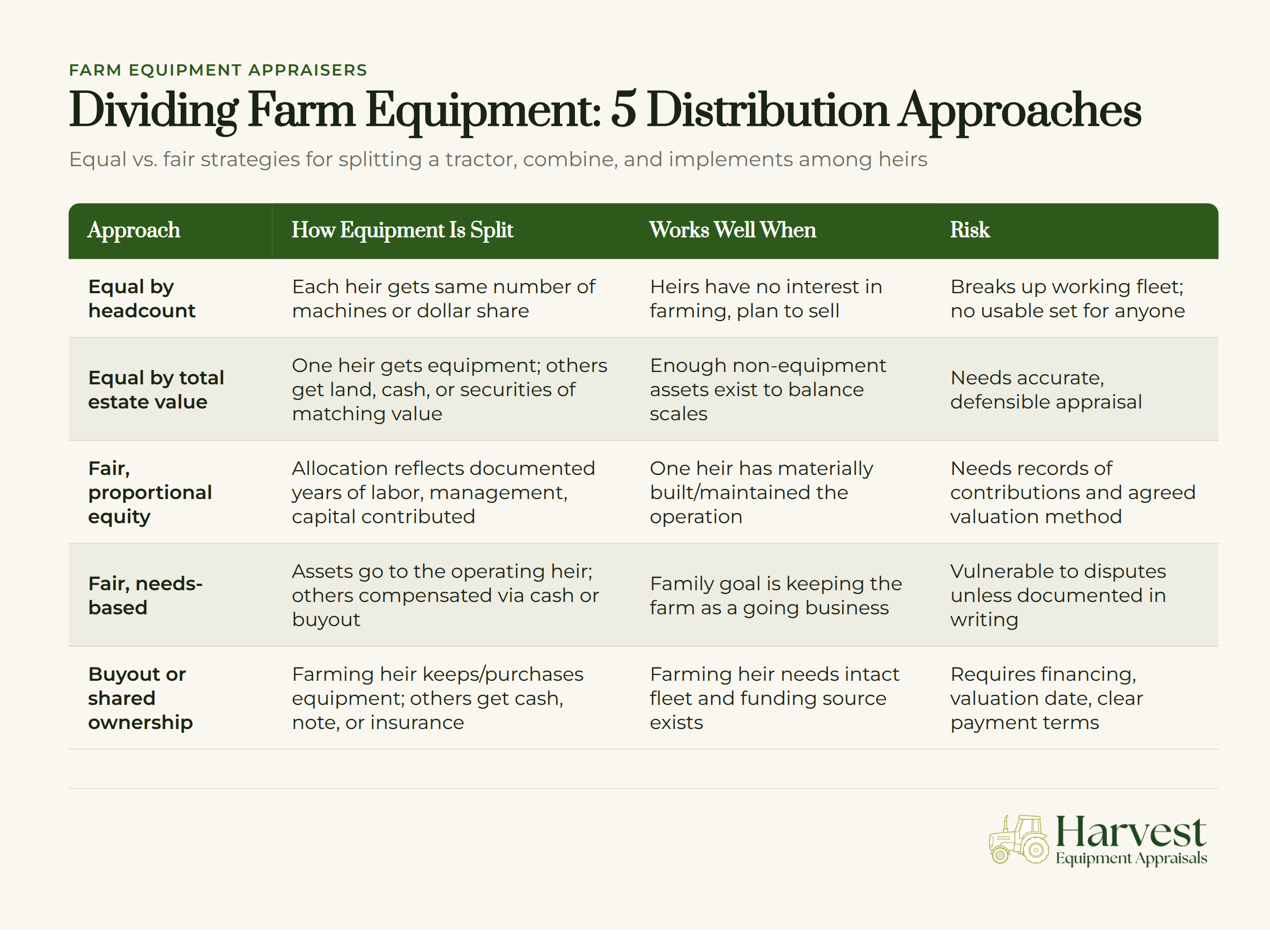
The table below lays out how the two approaches typically play out when a family divides a machinery line that includes a tractor, a combine, and several implements.
| Approach | How equipment is split | Works well when | Risk | |---|---|---| | Equal by headcount | Each heir gets the same number of machines or the same dollar share of the pool | Heirs have no interest in continuing to farm and plan to sell everything | Breaks up a working fleet; no one heir ends up with a usable set | | Equal by total estate value | One heir gets equipment; others get land, cash, or securities of matching value | There are enough non-equipment assets to balance the scales | Requires an accurate, defensible appraisal to set the matching values | | Fair, proportional equity | Allocation reflects documented years of labor, management, and capital the farming heir contributed | One heir has materially built or maintained the operation over time | Needs records of contributions and an agreed way to value them | | Fair, needs-based | Assets go to the heir who will keep operating; others are compensated through cash or buyout terms | The family's goal is to keep the farm as a going business | Vulnerable to disagreement unless the plan is documented in writing | | Buyout or shared ownership | Farming heir keeps or purchases the equipment; other heirs receive cash, a note, or insurance proceeds | The farming heir needs an intact fleet and the family has a funding source for the buyout | Requires financing, a valuation date, and clear payment terms |
Start With a Neutral Number: Why an Independent Appraisal Matters
Before any heir agrees to a buyout, cash settlement, or asset swap, the family needs a number everyone trusts. An independent farm equipment appraisal establishes fair market value for every tractor, combine, and implement in the estate, separate from what any one heir thinks the equipment is worth or what a sibling remembers it costing new.
Book value is not a reliable substitute. A combine that is fully depreciated on paper can still carry significant market value, and that gap matters enormously once heirs start negotiating who owes whom. A credentialed appraisal documents each machine's hours, condition, attachments, and comparable sales data, which turns a family argument into a line-item conversation. For estates with a large, mixed fleet, a full fleet appraisal values every machine individually so heirs can see exactly what each piece contributes to the total.
Farm equipment appraisals are quoted as a fixed fee after we scope the assignment, generally starting around $295 for a standard report and $395 for an IRS-qualified report, with typical engagements running $695 to $2,200 depending on the number of machines and the depth of documentation required. A large, complex fleet with specialty or high-value equipment can run higher. The fee reflects the scope of the work, not the value of the equipment being appraised.
Pro tip: Order the appraisal before heirs start negotiating informally. Once siblings have already floated numbers to each other, an appraisal that lands differently can feel like it's taking sides, even when it's simply accurate.
Funding the Buyout Without Selling Equipment
Once the appraisal sets a neutral value, the farming heir usually owes the off-farm heirs the difference between what they're keeping and what an equal share would have been. The challenge is funding that difference without forcing a fire sale of the equipment the farming heir needs to keep working.
Life insurance is one of the most common tools for solving this. A policy on the parent's life, sized to roughly match the expected buyout amount, pays out directly to the off-farm heirs (or into a trust that distributes to them) at death. The farming heir keeps the tractor, combine, and implements intact, and the siblings receive liquid cash instead of a fractional, unusable interest in machinery they'll never operate.
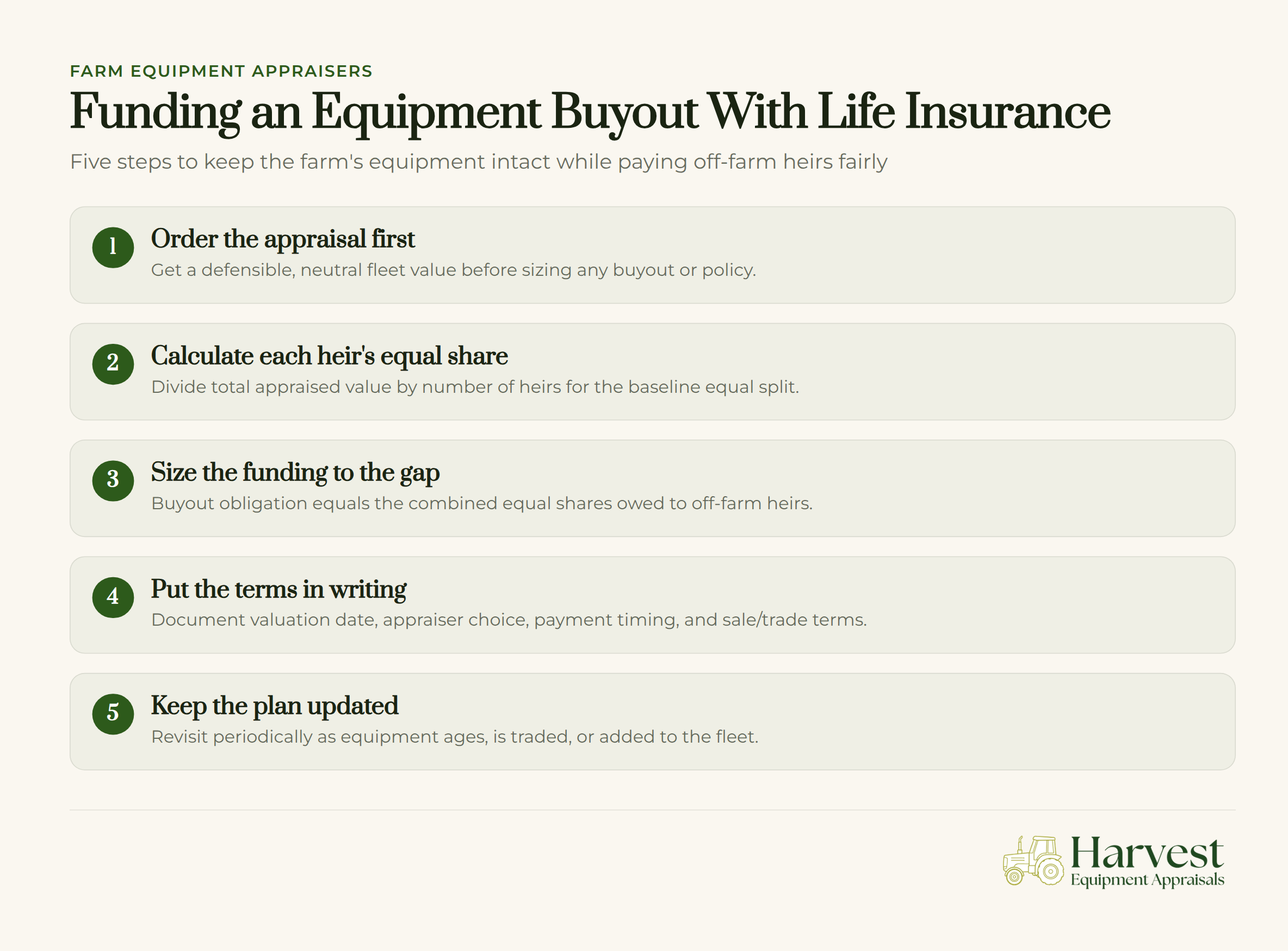
- Order the appraisal first. You need a defensible fleet value before you can size a buyout or a policy to match it.
- Calculate each heir's equal share. Divide the total appraised equipment value by the number of heirs to find the baseline each one would receive under a strictly equal split.
- Size the insurance (or other funding) to the gap. The farming heir's buyout obligation equals the combined equal shares owed to the off-farm heirs.
- Put the terms in writing. Document the valuation date, who selected the appraiser, payment timing, and what happens if a machine is sold or traded later.
- Keep the policy or buyout plan updated. Equipment values change as machines age, are traded, or are added to the fleet, so revisit the plan periodically rather than treating it as a one-time event.
Where a life insurance policy isn't in place or doesn't fully cover the gap, families sometimes use a secured promissory note instead, with the farming heir paying off the balance to siblings over several years at an agreed interest rate. Either way, the goal is the same: the equipment stays whole, and the off-farm heirs get value they can actually use.
Stepped-Up Basis: How the Appraisal Date Affects Heirs' Future Taxes
The appraised value used to settle the estate doesn't just divide the equipment fairly today. It also sets each heir's tax basis going forward. Under federal tax rules, an heir's basis in inherited property is generally the fair market value on the date of death, or the alternate valuation date if the executor properly elects one on the estate tax return (IRS Publication 551). This is often called a stepped-up basis, and it matters more than most families realize.
Example: A tractor the parent bought years ago for $40,000 and fully depreciated on the farm's books might appraise at $85,000 at the date of death. The heir who receives that tractor inherits it with an $85,000 basis, not the parent's original cost or remaining depreciated book value. If that heir later sells or trades the tractor for $80,000, there's little to no taxable gain, because the stepped-up basis already reflects most of the machine's value.
This is one more reason the appraisal needs to be accurate and well-documented at the time of death, not estimated after the fact. A deeper look at how this plays out for farm equipment specifically is covered in our guide to stepped-up basis for inherited equipment.
Watch out: For 2026, the federal estate tax exclusion is $15 million per individual, so most farm estates won't owe federal estate tax at all (current federal estate and gift tax exclusion figures). That threshold determines whether a return is required or elected, not how the equipment should be divided among heirs. Even estates well under the threshold benefit from accurate valuation, both for fair division and for the stepped-up basis heirs will rely on later.
A Worked Example: Three Heirs, One Combine, One Fair Outcome
Here's how the numbers can come together for a typical family. A farm estate includes a tractor, a combine, a planter, tillage equipment, and a grain cart. An independent appraisal values the complete fleet at $900,000 as of the date of death.
There are three heirs: Heir A farms full time and wants to keep the equipment running the operation. Heirs B and C live off the farm and have no interest in machinery.
- Equal share by headcount: $900,000 divided three ways is $300,000 per heir.
- Heir A's position: Heir A keeps the full $900,000 fleet, which means Heir A owes Heirs B and C $300,000 each, or $600,000 total, to make the split fair.
- The funding source: The parent had a $600,000 life insurance policy payable to Heirs B and C. The payout covers their combined buyout obligation in full, in cash, without Heir A borrowing against the farm or selling a single machine.
- The result: Heir A keeps a complete, working fleet with a stepped-up basis of $900,000 across the equipment. Heirs B and C each receive $300,000 in cash, equal to their share of the appraised value, with no ongoing stake in equipment they'd never use.
If no life insurance had existed, the family could have reached a similar outcome with a secured note from Heir A to B and C, paid over 5 to 10 years at a stated interest rate, with the equipment itself (or the land) pledged as collateral until the balance was paid.
Putting the Plan in Writing
A fair outcome only holds up if it's documented. The agreement or estate plan should specify the valuation date, which appraiser was used and why, how attachments and implements were treated, and what happens if the farming heir later sells or trades a piece of equipment. If the estate files IRS Form 706, supporting valuation documentation, including an independent appraisal, helps substantiate the equipment values reported on the return, though the form itself doesn't universally mandate a qualified appraisal for every estate (IRS guidance on estate tax filing).
Dividing farm equipment among heirs is rarely just a math problem. It's a family moment layered with history, expectation, and sometimes grief, and it goes a lot smoother when the numbers are settled by a neutral third party rather than by memory or guesswork. An independent appraisal gives every heir the same starting point, and a well-structured buyout, whether funded by insurance, a note, or other estate assets, lets the farm keep running while everyone involved gets their fair share.
If your family is working through an equipment division and needs a defensible, independent valuation to build the plan around, our team can schedule a farm equipment appraisal sized to your fleet and your timeline.
This article is provided for general informational purposes only and does not constitute legal, tax, or financial advice. Readers should consult a qualified attorney or CPA regarding their specific circumstances.