
Blog
MACRS Depreciation for Farm Equipment: When Appraised Value Sets Your Depreciable Basis
MACRS depreciation farm equipment basis starts with cost, and an appraisal sets it only in specific cases such as inheritance, conversion to farm use, and multi-asset purchases. This guide shows which situations call for fair market value and how the 5-year and 7-year classes, business-use percentage, and conventions shape the deduction.
Published
Key Takeaways
Here is what farmers and their CPAs need to know about MACRS depreciation basis for farm equipment:
- Purchases: Depreciable basis for equipment bought from an unrelated seller is cost, meaning the price plus sales tax, freight, and installation. An appraisal does not override the purchase price.
- Inheritance: Inherited equipment generally takes a basis equal to fair market value at the date of death, and an appraisal documents that value. The stepped-up basis guide for inherited farm equipment covers the heir's side in more detail.
- Other triggers: Conversion from personal to farm use, gifts, contributions to entities, and multi-asset farm purchases also turn on documented fair market value. A farm equipment appraisal from Harvest Equipment Appraisals supplies that documentation.
- Mechanics: Basis is reduced by the business-use percentage, by any Section 179 or bonus depreciation taken, and then recovered over a 5-year or 7-year class under a half-year or mid-quarter convention.
MACRS depreciation basis for farm equipment begins with what the taxpayer paid, not with what an appraiser concludes. The appraisal matters when the tax rules call for fair market value, or when a lump-sum price has to be split across many assets. This guide walks through each situation, the MACRS mechanics that follow, and a worked example for an inherited tractor.
How Is Depreciable Basis Determined for Farm Equipment?
Depreciable basis for farm equipment is generally the taxpayer's cost or other legally determined basis, multiplied by the percentage of business use. IRS Publication 225, the Farmer's Tax Guide, lays out the five MACRS inputs: the depreciation system (GDS or ADS), the property class and recovery period, the placed-in-service date, the depreciable basis, and the applicable method and convention.
For a purchase from an unrelated seller, cost includes the invoice price plus capitalized acquisition costs such as sales tax, freight, and installation. An appraisal of that tractor or combine is useful corroboration, but the arm's-length price controls. A higher appraised value does not raise the basis, and a lower one does not reduce it.
Watch out: Depreciating equipment at appraised value after an ordinary purchase is a common error. The appraisal documents value; the governing basis rule decides which number enters the schedule.
When Does an Appraisal Set or Support Depreciable Basis?
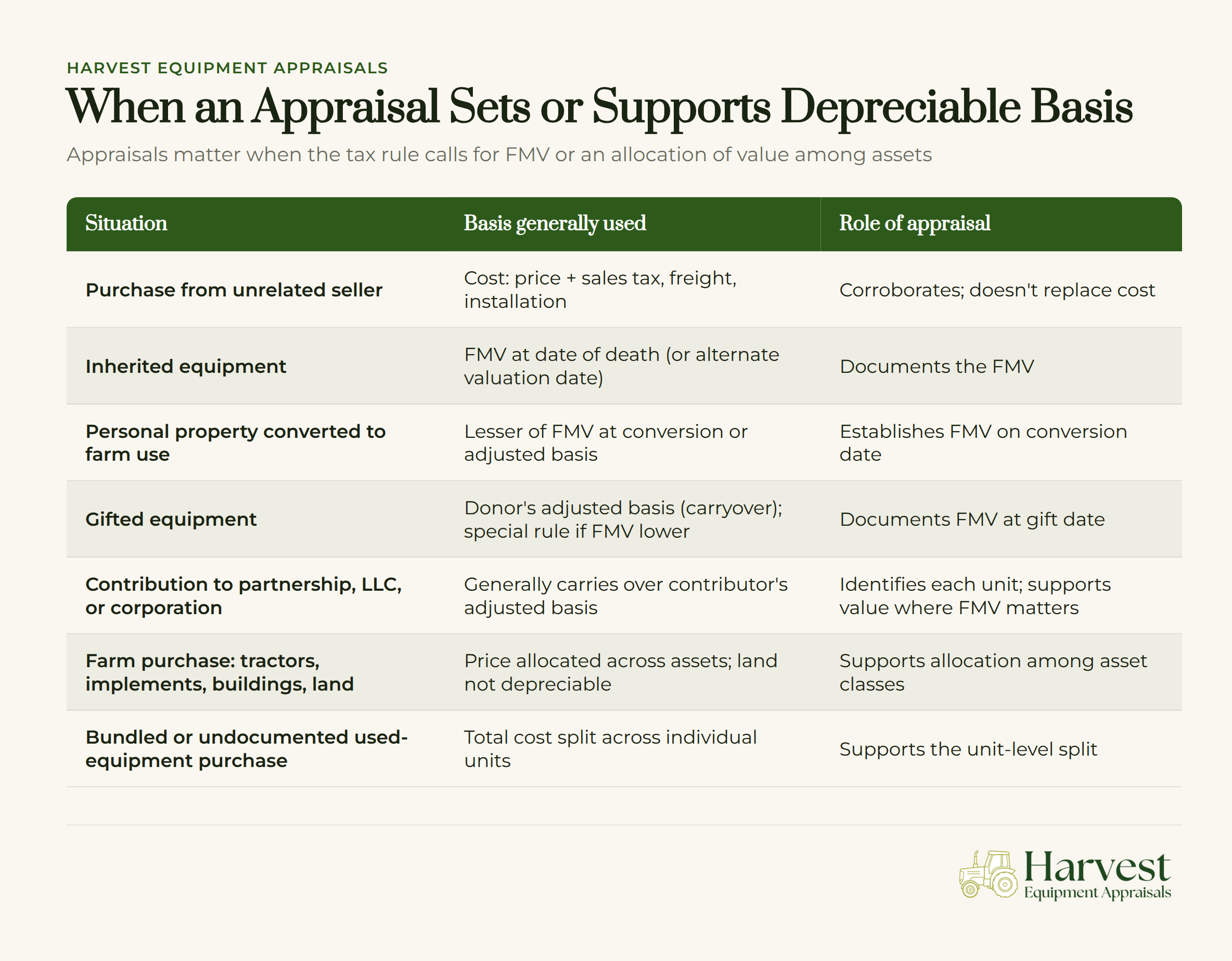
An appraisal sets or supports basis whenever the tax rule calls for fair market value (FMV) or an allocation of value among assets. The table below summarizes the situations a farm operation encounters most often.
| Situation | Basis generally used | Role of the appraisal |
|---|---|---|
| Purchase from an unrelated seller | Cost: price plus sales tax, freight, installation | Corroborates; does not replace cost |
| Inherited equipment | FMV at date of death (or alternate valuation date if elected) | Documents the FMV |
| Personal property converted to farm use | Lesser of FMV on conversion date or adjusted basis | Establishes FMV on the conversion date |
| Gifted equipment | Generally the donor's adjusted basis (carryover), with a special rule when FMV is lower than basis | Documents FMV at the gift date |
| Contribution to a partnership, LLC, or corporation | Generally carries over the contributor's adjusted basis | Identifies each unit and supports value where FMV matters |
| Farm purchase with tractors, implements, buildings, and land | Purchase price allocated across the assets; land is not depreciable | Supports the allocation among asset classes |
| Bundled or undocumented used-equipment purchase | Total cost split across individual units | Supports the unit-level split |
Inherited Equipment
Inherited farm equipment generally takes a basis equal to its FMV at the date of death. The heir starts a new depreciation schedule on that stepped-up amount, regardless of how much the decedent had already deducted. A retrospective appraisal as of the date of death is the standard way to document the value.
Personal-to-Farm Conversion
A taxpayer who moves a personal-use tractor or truck into a farm business uses a basis equal to the lesser of FMV on the conversion date or adjusted basis, as IRS Publication 225 explains. The appraisal directly caps the depreciable basis in this case, so the conversion date and the appraisal date must line up.
Gifts and Entity Contributions
Gifted equipment generally carries over the donor's adjusted basis, and a contribution to a partnership, LLC, or corporation generally carries over the contributor's basis. FMV still matters for the gift loss rule and for allocating value among contributed assets. A unit-by-unit appraisal gives the CPA a defensible record.
Farm Purchases and Bundled Deals
A buyer who acquires an operating farm for one price must allocate that price among the acquired assets. Land is not depreciable, buildings are depreciated over a long recovery period, and tractors and implements fall into the shorter equipment classes. Allocation rules for business acquisitions (Internal Revenue Code Section 1060, reported on Form 8594) call for FMV evidence, and an appraisal of the equipment supports the amount assigned to it.
How Does Business-Use Percentage Reduce Basis?
Business-use percentage reduces depreciable basis in direct proportion to farm use. The depreciable basis equals the cost or FMV basis multiplied by the share of use that is business or farm use.
Example: A $100,000 tractor used 80% on the farm and 20% personally has an $80,000 business basis before any other adjustments.
The percentage applies to inherited and converted equipment as well. Mileage logs, hour-meter readings, and field records give the CPA the support for the percentage claimed.
Is Farm Equipment 5-Year or 7-Year Property?
New farm machinery placed in service after 2017 is 5-year property, and used farm machinery is generally 7-year property. Publication 225 treats machinery and equipment used in a farming business as 5-year property only when its original use begins with the taxpayer after 2017. Equipment bought used, or received by inheritance, does not meet the original-use test and stays in the 7-year class.
Publication 225 also states that the 150% declining-balance method is no longer required for 5-, 7-, and 10-year farm property placed in service after 2017. The class, method, and table percentages should be confirmed against Publication 225 and IRS Publication 946 for the specific asset and tax year.
Harvest Equipment Appraisals often sees classification questions because make, model, model year, and acquisition history decide the class. The appraisal report records those identifying details for each unit, which the CPA then uses to confirm the class.
What Does Placed in Service Mean for Farm Equipment?
Placed in service means the equipment is ready and available for its specific intended use. The purchase date, delivery date, and first-use date do not control. A planter bought in November but not ready for use until spring is generally placed in service in spring.
The placed-in-service date drives the first-year convention. Two conventions apply to equipment:
- Half-year convention: The default. Equipment is treated as placed in service at the midpoint of the tax year, so the first year carries a half-year of depreciation.
- Mid-quarter convention: Applies when more than 40% of the year's depreciable basis is placed in service during the last 3 months of the tax year. Each asset is then treated as placed in service at the midpoint of its quarter, which reduces first-year deductions for late-year purchases.
Pro tip: A farm that buys several large machines in October through December should run the 40% test before year-end. Publication 946 sets out the test and the excluded categories of property.
How Do Section 179 and Bonus Depreciation Affect Basis?
Any Section 179 deduction and any special depreciation allowance reduce the basis before regular MACRS depreciation is figured. Only the remaining basis is recovered under the 5-year or 7-year table. The mechanics of expensing and bonus depreciation are covered in a separate FAQ on what qualifies for 100% bonus depreciation, so this guide does not repeat them.
An appraisal never creates a Section 179 or bonus deduction. The equipment must qualify independently, and the appraisal only supports the basis to which those provisions apply.
Worked Example: Inherited Tractor With an Appraised Date-of-Death Value
An heir inherits a used tractor. The decedent paid $210,000 years earlier and had fully depreciated it. A retrospective appraisal concludes an FMV of $90,000 at the date of death. The heir uses the tractor 80% for the farm and 20% personally, and places it in service in April.
The table below shows the basis and the first 3 years of depreciation. The calculation assumes the standard GDS 7-year table with the half-year convention, and no Section 179 or bonus depreciation.
| Step | Amount |
|---|---|
| Decedent's original cost (not used) | $210,000 |
| Basis to heir: FMV at date of death | $90,000 |
| Business-use percentage | 80% |
| Depreciable basis ($90,000 x 80%) | $72,000 |
| Class (used, inherited; fails original-use test) | 7-year |
| Year 1 (14.29%) | $10,288.80 |
| Year 2 (24.49%) | $17,632.80 |
| Year 3 (17.49%) | $12,592.80 |
| Total deducted, years 1 to 3 | $40,514.40 |
The decedent's $210,000 cost has no effect on the heir's schedule. The appraised $90,000 FMV is the entire starting point, which is why the quality of the appraisal matters. An overstated value invites challenge, and an understated value gives up deductions.
What Should an Appraisal Used for Basis Contain?
An appraisal that supports a depreciation basis should give the CPA everything needed to compute and defend the figure. A credible report includes the following items:
- Valuation date: The date of death, conversion date, gift date, or acquisition date, stated explicitly.
- Unit identification: Make, model, serial number, model year, hours, and condition for each machine.
- Value definition and method: The FMV definition and the comparable sales or other methods used.
- Allocation detail: For multi-asset deals, the value assigned to each unit and its asset class, with land separated out.
- Standards statement: A statement that the report is prepared in accordance with USPAP.
Our appraisers hold credentials with leading organizations such as the ASA and CAGA, and machinery and equipment work also draws on training from bodies such as NEBB. USPAP is published by The Appraisal Foundation. Fees are quoted as a fixed fee before work begins and are driven by scope: the number of units, the quality of the records, the complexity of the assets, and the intended use.
Document Basis Before the First Depreciation Deduction
MACRS depreciation on farm equipment rests on a basis that must be documented at the moment it arises. For purchases, that means invoices and closing statements. For inheritance, conversion, gifts, entity contributions, and farm acquisitions, that means a dated appraisal that the CPA can attach to the return file. Harvest Equipment Appraisals prepares those reports so the basis, the class, and the allocation are supported before the first deduction is claimed.
This article is provided for general informational purposes only and does not constitute legal, tax, or financial advice. Readers should consult a qualified attorney or CPA regarding their specific circumstances.